Showing posts with label history. Show all posts

Wednesday, May 10, 2006

Review of the Feast of Roses by Indu Sundaresan

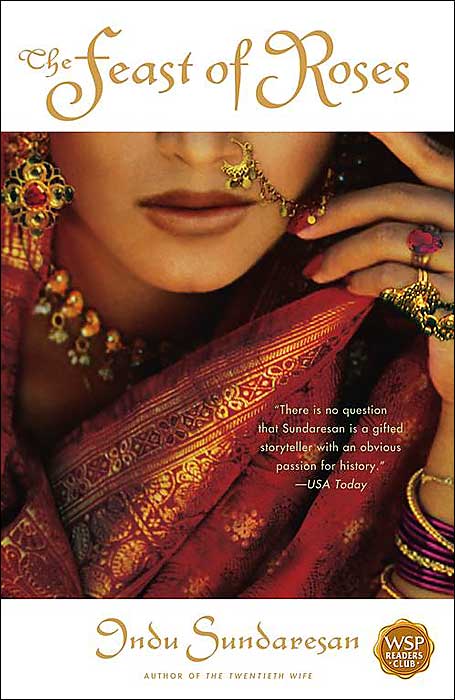
Book Review: I just completed The Feast of Roses, by Indu Sundaresan, the sequel to The Twentieth Wife, which I reviewed HERE. I don't really see The Feast of Roses as a sequel -- the two books, in my view, were simply split up for marketing reasons. Nonetheless, I am really bummed to be done with this book. My evenings have been entertained for maybe 3 weeks now by Sundaresan's lovely and engaging story -- what am I going to read now? Here is a snippet from a great review by Wesley Burnett available HERE:

My outline of world history says only that Jahangir was given to drink, and that, as Empress, Mehrunnisa ran the show. It wasn't that easy, of course. Mehrunnisa, who repeatedly reflects that she wishes she were a man, forms a junta with her father, brother and the heir-apparent to the throne, Shah Jahan, and ruthlessly exploits Jahangir's love to seize ever increasing authority and power. In the process she violates most conventions of Mughal society. For starters, she leaves the zenana, the harem, to stand beside her husband at public audiences where she begins making official pronouncements. This offends Jahangir's advisors who are also his lifelong friends, male chauvinist pigs that they are.

Well, possibly they are, but as the story progresses, it becomes ever more difficult to sympathize with Mehrunnisa. She is the most powerful person in the world's most advanced civilization, but while she is wily as a fox, she isn't necessarily wise as an owl. She crushes opposition in the zenana where she ruins lives and alienates her few supporters. They get their revenge. A well-contrived accident terminates Mehrunnisa's pregnancy and her potential for mothering a dynasty. She exiles Jahangir's chief advisor to Kabul where he swears vengeance. She has to arrange a less than desirable marriage for her daughter who is unenthusiastic about producing males who will have to fight for the throne. Even her co-conspirators in the junta come to despise her.

Mehrunnisa's turn for the dark side was nicely portrayed by Sundaresan. The Twentieth Wife, she was a bit fluffy, and wide eyed - this was definitely not the case in The Feast. Her transformation and intoxication with power was engaging to observe, and forms a strong theme in the book. The sense of place and history was very well done. I highly recommend this series to any one, but particularly anyone interested in the Mughal period of rule in Indian history. I really hope Sundaresan keeps writing sequels until eventually reaching modern day India.

If only my history books were half this engaging. It gets quite boring seeing the fomulaic spattering of who conquered who, when and how fast in the dry discourse typical of historians. This historical fiction is so engaging, I may have to go find another one now. Please let me know if you have any suggestions. All in all I give Feast of Roses 3 1/2 out of 4 stars.

Friday, April 21, 2006

review of the twentieth wife by indu sundaresan

book review: i just finished the twentieth wife by indu sunderesan, a local writer from bellevue. my sister-in-law met the author at a house party and recommended the book to my wife. what a page turner. i had a really tough time putting it down. one of the reasons i love historic novels is i get an in depth flavor for how life was in a different era - much more so than in a film. in this case, it was particularly interesting getting another view on the moghuls, a band of brutes not depicted so well by most sources, certainly not by the sikh sources of my youth.

sunderesan has a nice descriptive style that's not too simplistic, nor too over the top. my wife read this book for her book club, but due to the cover (i often violate the cardinal rule to not judge a book by its cover) - i dismissed it as chic lit. well it is chic lit, but sometimes i suppose that's ok.

here's a snippet of a high level summary of the book courtesy of diesel-ebooks.com:

An enchanting seventeenth-century epic of grand passion and adventure, this debut novel tells the captivating story of one of India's most legendary and controversial empresses -- a woman whose brilliance and determination trumped myriad obstacles, and whose love shaped the course of the Mughal empire. She came into the world in the year 1577, to the howling accompaniment of a ferocious winter storm. As the daughter of starving refugees fleeing violent persecution in Persia, her fateful birth in a roadside tent sparked a miraculous reversal of family fortune, culminating in her father's introduction to the court of Emperor Akbar. She is called Mehrunnisa, the Sun of Women. This is her story.

on a more literary and critical note, i'd say sunderesan, while capitivating, fails to write with much literary force. she fails to critically assess, and expose, the emporers in their utter brutality. she mentions a few things here and there, but these scenes could have been explored in more depth. my guess is she's walking a fine line - tough to empathize too much w/ this woman that is so in love w/ a guy that romances w/ 300+ wives - not to mention is a wake-n-bake opium snorting son eye-poking loser by any modern sense. also, the ali qul character, mehrunnisa's husband, is displayed as a simplistic brute - would have been nice to get much more background and depth, especially given that he performs significant acts.

anyway, while its no literary masterpiece, it's certainly a step up from the divince code w/ all the grip. also, if all i read were literary masterpieces, i'd probably sleep more than 8 hours a day. i give this book 3 stars overall out of 4.

Tuesday, March 28, 2006

two lives by vikram seth

book review: i just finished vikram seth's new book called two lives. he's such a lovely author. the book's about vikram seth, and his view of his uncle and aunt and their lives. the author was sent to live with his mamaji and his jewish german wife in england. he spends his college days with them, and grows quite attached. seth tracks their lives througout the rise of hitler during their years in berlin, and then through the war and post war years. much of hennie's family gets murdered by the nazi's, but she makes it to england. what i especially enjoyed was being welcomed into seth's challenge of how to recreate his aunt and uncles lives after his aunt had already passed on, and his uncle was very old. you could feel him struggling to write the book with whatever materials he had. all in all a nice read. i give it 3 stars out of 4.

Sunday, December 18, 2005

sukharan

the past 3 days we've been in sukharan, my maternal ancestral village, staying with gurpreet paji (my cousin) and my mamiji (mother's brother's wife). it's been a blast and it appears nayan's intestinal friend is on its way out. sukharan is a small pind, about 70 houses surrounded by flat and fruitful farmland. we've spent a good part of the day chatting with all of our village elders about our family and the village history.

sukharan was started about 150 years ago by my grandfather's grandfather's grandfather himat singh. himat singh's father, fauja singh, lived in a yellow house in rotinda. i doubt the house was yellow some 200 years ago, or had a soccer ball water tank on the roof as it does now (we drove by the other day). anyway, fauja singh is the last of our lineage that my cousin sukhi can remember off the top of his head. without blinking, sukhi informs me of over 150 years worth of family lineage. he tells me that my grandfather gurbachan singh, had 2 brothers, one shiv singh, who's grandson is gurpreet. the other brother, banta singh, had one son charanjit singh, who's wedding pictures, all black and white, show photos of me, a spitting image of nayan at 5 years of age. his son is sukhi.

sukhi lives in another yellow house that himat singh first built when maharaja ranjit singh gifted him 500 acres of land for being a 'brave and fearless' brigadier general in the raja's army. for those who don't know, maharaja ranjit singh was the first and only sikh king to conquer all of the punjab, modern day punjab, haryana, himachal, much of kashmir, pakistani punjab, and lands into afghanistan. his reign rendered one of the few moments of calm in an otherwise violent punjab history, as much of the conquering was done via clever negotiation. after many more mukhi de rotis, our complete line was revealed: i.e., himat singh was the son of fauja singh, and father of mehtab singh (a colonel in the rajas army), father of gopal singh, father of inder singh, who was the father of our 3 grandfathers.

while writing this, i'm realizing this all reads like the introduction to a shakespeare play. anyway, over dinner, one of my mamijis reveals that himat singh's masi's (mothers sister) daughter was maharani jind kaur, the 7th (and i'm told most beautiful) of 7 wives of the maharaja. so it seems, her parents, after discovering a babe of a daughter, saw an opportunity to expand the family fortune. they convinced the maharaja that 6 wives was not enough, and that he should check out their daughter. well i guess it all worked out, since himat singh was made a general, and our family prospered. another interesting tid bit, himat singh, on leaving the army, and taking land in lieu of a pension for his service, left his home in rotinda, and travelled about 2 kilometers to build a house on his new land. he brought with him his faithful servants. the servants, now politically correctly referred to as 'aatarmi', or the oppressed ones, it seems have far outbred the jats.

we jats form the warrior caste (and farmers, since warring used to be a part-time profession) within hinduism. none of this caste stuff should matter since caste-ism is officially banned in both the indian constitution, and the sikh faith, but alas, it certainly does. nearly all the punjabi jats became sikhs beginning around the 15th century. i'm informed that now only 5 out of the 70 houses in the village are "ours," though nearly all of the land is. as i roam the village, everyone knows who i am. its a serene pastoral place; no buzzing scooters, sputtering auto rikshas, black cloud bellowing trucks, or skanky red paan stains. the local police are annoyed that there's "no money to be made in sukharan." translation: everyone gets along, no drunken fights followed by law breaking, and the need to bribe the police to get off. it's also true that i'm related to everyone (jats) in the village. we drink chai, and eat barfi at each of our 5 houses, the members of which all fit somewhere in the lineage down from himat singh.

sukhi informs me that in rotinda, all the jats are gosals. they're often called 'billean', or the cats, beacause nearly all have green eyes (a rarity in brown eyed india). only 1 of the gosal lines in sukharan got the bille gene. i am eating with one of my more distant mami's (mother's brother's wife) and i nearly jump out of my seat. i suddenly recognize her eyes, from 30 years ago. she was then veiled in black wearing garlic over her mouth, and red chilli peppers around her neck, screaching through the village chasing us children (its an old wedding tradition in our village). i was terrified. my sister, cousins and i lied shaking under a bed for hours.

sukhi says the gosal line moved to rotinda about 450 years ago. he's going to rishikesh this summer, where our family pundit can track our lineage back many more hundreds of years.
Related Posts with Thumbnails

Liked what you read? Tell your friends

More info about content in my post