
Life, Review: Yesterday, Nayan and I rode our bikes down to the Sunset Hill Community club to see Frog Lake by the Thistle Theater folks. Here's a snippet from their website:
Enjoy the classic ballet Swan Lake transformed into a contemporary ballet, Frog Lake. Taddy, a young frog, is excited to be seeing her first ballet at her local pond. As the Conductor Frog enters the theater a hush falls, broken only by the sound of frog croaks and cricket chirps. On cue, fireflies flit to their respective footlights to illuminate the stage of the “Ballet de Pond”. Traditional choreography will be brought to life as the frogerinas dance to Tchaikovsky’s famous music.
I really wanted to like this, but I realized it had some fundamental problems. First, its a parody of a ballet. If you know anything about kids, it should be that they don't get irony or sarcasm, and certainly not parodies. So, you say, surely the intent is to entertain the adults, and that the puppets themselves are sufficient to keep the kids engaged. Well, if you know a bit more about kids, or atleast boys, its that the idea of "Silent" anything just doesn't work. Another problem could just be my testerone hang ups, but frankly, of all the fine arts, the one I like the least, is ballet. But atleast in real life, you can admire the physicality of the dance - but with puppet frogs very seriously leaping around in frog leotards? It could work if you embraced the stupidity, and cracked jokes about it - but alas, the "Silent" part killed that possibility. So, every time the main frog would come on stage, a cackle of 3 year olds would start shouting, "Oh no! Not that guuuuuy again." The theatre director, opens the show by admonishing the kids for yapping, and pleads for the mothers to assist. So, innevitably, the play was spent w/ mom's in a tizzy, trying to keep their bored kids engaged.
Just to keep up the bashing, I also, was utterly unimpressed with the set design - only a couple scene changes! The one thing that kept it from being a disaster, is that the puppets were fairly well done. This, from the Thistle Theater folks, who usually skimp on both set design and puppets. The Peter Rabbit puppets w/ the exception of the farmer, were something out of Wal-Mart, but alas, atleast he spoke.
Why, you might ask, am I harshing on the artistic merit of kids puppets? Well, this IS Seattle, where we not only have the good fortune of having puppet options, but most of the kids puppet theater is simply amazingly well done. The North West Puppet Theatre's renditions of both Babar and Madelaine were just beautiful and engaging - the kids and adults were enthralled; the set changes continuously and in a fairly complex manner. There's also this local couple that does a Spanglish version of a Mexican burrito guy that is by far the best puppet production I've seen with stunning hand painted (like by a real artist, and a good one at that) scenery, and the young couple are just amazing performers.
Sunday, May 07, 2006


Thursday, May 04, 2006
That Glazed Laptop Look
Politics, Life: CSM has an interesting article called Professors want their classes 'unwired' by Maia Ridberg. I've always thought this whole obsession of getting kids intertwined with their laptops is a bit manic. Here's a snippet:
When Don Herzog, a law professor at the University of Michigan, asked his students questions last year, he was greeted with five seconds of silence and blank stares.
When Don Herzog, a law professor at the University of Michigan, asked his students questions last year, he was greeted with five seconds of silence and blank stares.
He knew something was wrong and suspected he knew why. So he went to observe his colleagues' classes - and was shocked at what he found.
"At any given moment in a law school class, literally 85 to 90 percent of the students were online," Professor Herzog says. "And what were they doing online? They were reading The New York Times; they were shopping for clothes at Eddie Bauer; they were looking for an apartment to rent in San Francisco when their new job started.... And I was just stunned."
This seems obvious - computers, especially well wired machines, can be an incredible distraction; on occasion I will work from a cafe, or somewhere I am not wired, just so I can focus - I often go out of my way to unplug from IM apps, shut off my email notification, etc.
I held a meeting the other day, and a few folks hauled their laptops in. My team is extremely busy these days, and I strive to keep meetings very short so team members can get on with their work. The mere presense of these machines, while well meaning - to look up relevant information here and there, ended up distracting the two team members, and dragging the team meeting out.
Here's another entertaining quote from a student in Ridberg's article:
"Every single person I have ever seen bring a computer to class has also surfed the Web or been on IM," says Amy Kornell, an undergraduate at the University of California at Davis. "I saw one girl watch a whole episode of 'Gray's Anatomy.' But I would guess that solitaire is the most popular game."
Tuesday, May 02, 2006
Frogs on Granville

Life: We spent this weekend up in Vancouver visiting Ameen's family. Was a nice, relaxing trip. Saturday was intermittently blustery - we ran through some storms while passing through Bellingham, then it just sort of rained. Sunday, however, was sunny and bright -- a picture perfect spring day in the northwest.
Ameen spent about 15 years of her life studying, then printing/art making, on Granville Island in Vancouver. Whenever we're in Vancouver, Ameen gets an amazing itch to head to Granville. It's a lovely place, so of course I also now get this itch. For anyone visiting Vancouver, you can find out more at www.granvilleisland.com.
We got a chance to catch up with our good friend Peter who owns and runs New Leaf Editions, a fine printmaking studio on the island. Peter's a tad eccentric, and amongst other interesting Peter-isms, he has an exhaustive collection of frogs. Nayan was fascinated by the 40+ odd years of frog collecting Peter's been doing. His studio is full of frogs - coat hanger frogs, clock frogs that sing Irish drinking tunes, dancing frogs with red rubber tongues, and dead Japanese ones with a zipper instead of legs to hold coins, to name a few.
One of the joys of parenthood is seeing the fascination and enjoyment of the simple every day things we long since learned to tune out. Ananya, at the site of some rather standard ducks, was shreaking like a very happy banshee.
Monday, May 01, 2006
News Feeds and other Site Info
Tech: I recently installed Google Analytics, so I can get an idea of what you all do on this website, and how I might be able to improve it. As an aside, Google Analytics is an order of magnitude better than any site analysis tool I've used. The Google folks have perhaps the most elaborate and effective use of AJAX I've seen on the web. Among other things, I get to see which links people are using, how they enter the site, how often they simply bounce back out, where they come from, geographical maps, etc.
One of the things I learned is that many of you aren't using RSS feeds, but are periodically visiting the site (mostly by Googling for Chalo Bolo). That's not a bad thing, if I were a more diligent poster, but I suspect many of you get mildly annoyed to find out that I haven't posted in a while. So I recommend using a consolidated viewer like Bloglines; with a blog lines, or similar account, you can keep all the news, blogs, etc. that you read at one URL, then you can automatically see which of your sites have new content, summaries of the posts, etc. You can usually simply add the URL of your sites, and almost every site, including blogs and more popular sites like the NYT, Christian Science Monitor, etc. all support RSS feeds.
Another thing I learned, is that many of you are repeatedly following the Topic links off to the right of this post, which is great. For those of you who have not, I'll briefly explain. For each post I make, I tag the post w/ certain classifications, like: Life, Politics, Movie Reviews, etc. The links off to the right point to these posts. If all you're interested in are Movie Reviews, than you can simply follow that link and avoid the rest. And of course, if you're interested in all of it, you can ignore this advice all together!
One of the things I learned is that many of you aren't using RSS feeds, but are periodically visiting the site (mostly by Googling for Chalo Bolo). That's not a bad thing, if I were a more diligent poster, but I suspect many of you get mildly annoyed to find out that I haven't posted in a while. So I recommend using a consolidated viewer like Bloglines; with a blog lines, or similar account, you can keep all the news, blogs, etc. that you read at one URL, then you can automatically see which of your sites have new content, summaries of the posts, etc. You can usually simply add the URL of your sites, and almost every site, including blogs and more popular sites like the NYT, Christian Science Monitor, etc. all support RSS feeds.
Another thing I learned, is that many of you are repeatedly following the Topic links off to the right of this post, which is great. For those of you who have not, I'll briefly explain. For each post I make, I tag the post w/ certain classifications, like: Life, Politics, Movie Reviews, etc. The links off to the right point to these posts. If all you're interested in are Movie Reviews, than you can simply follow that link and avoid the rest. And of course, if you're interested in all of it, you can ignore this advice all together!
Thursday, April 27, 2006
FFVs and Lessons from Brazil
Politics: I ran across an interesting article titled Alternative Fuels - Lessons from Brazilia by Bill Siuru. In it, Siuru writes:
Something that has negatively biased my view of ethanol in the US, was the claim that it was just a huge government subsidy with no real benefit - the prime argument as I recall, was that the energy to produce ethanol, was so great, that it just wasn't worth it in the end. Siuru sites some interesting numbers, that back this up:
Fermentation of Brazilian sugar cane produces much more ethanol as compared to corn. For each unit of energy expended to turn cane into ethanol, 8.3 times as much energy is created (1 to 8.3.) Compare that to corn which gets a maximum of 1.3 times the engery from a single unit (1 to 1.3.) Research is underway in Brazil to increase this to 1 to 10. Also, no fossil fuel is used in the process of converting sugar cane to ethanol. The residue from the stalks is used to generate the necessary electricity, and to fertilize the sugar cane fields.
So it sounds like corn is the culprit, not ethanol in general. This is an interesting read. I'm surprised Brazil isn't being sited more on models to follow, or atleast study more, given their relatively minimal use of gasoline.
When oil prices dropped in the mid-1980s, coupled with the discovery of new offshore oil fields, gasoline became cheaper. This was further compounded by a drought and a poor sugar harvest disrupting the supply of alcohol. Then by 1989, sugar prices started to rise dramatically and producers exported sugar rather than turn it into fuel. By 1997, alcohol capable cars represented less than 1-percent of new vehicles sold in Brazil.
Brazil learned a lesson from these ups and downs. The result were flex-fuel vehicles (FFV) that could run on any fuel from pure gasoline to pure alcohol. All Brazilian gasoline is blended with at least 20- to 25-percent ethanol. Some 29,000 out of 31,000 fueling stations in Brazil also offer 100 percent ethanol for the older alcohol-only vehicles. Brazil currently has between 3-million and 4-million ethanol fueled vehicles.Something that has negatively biased my view of ethanol in the US, was the claim that it was just a huge government subsidy with no real benefit - the prime argument as I recall, was that the energy to produce ethanol, was so great, that it just wasn't worth it in the end. Siuru sites some interesting numbers, that back this up:
Fermentation of Brazilian sugar cane produces much more ethanol as compared to corn. For each unit of energy expended to turn cane into ethanol, 8.3 times as much energy is created (1 to 8.3.) Compare that to corn which gets a maximum of 1.3 times the engery from a single unit (1 to 1.3.) Research is underway in Brazil to increase this to 1 to 10. Also, no fossil fuel is used in the process of converting sugar cane to ethanol. The residue from the stalks is used to generate the necessary electricity, and to fertilize the sugar cane fields.
So it sounds like corn is the culprit, not ethanol in general. This is an interesting read. I'm surprised Brazil isn't being sited more on models to follow, or atleast study more, given their relatively minimal use of gasoline.
Mullahs and Gas
Politics: Thomas Friedman was on NPR the other day; he made a statement to the effect that he's happy either way with what happens in Iran. If the mullahs bow to the west and drop their nuke quest, grand. If they continue to push the US, then Bush et. al. will have no choice but to push for strong sanctions and the Euros are more apt to listen. This will have the innevitable impact of shaking the oil markets further, pushing gas prices even higher.
In Friedman's view, and I tend to agree, the higher the price of gas, and the longer it stays high, the quicker this nation, and others, can get off oil. This outcome is beneficial, not only because of the benefits of reduced green house emissions, but also due to reduced dependence of the US on volatile oil supplies and price fluctuations. Reducing green house emmissions makes me and the penguins happy. Reducing US oil dependence makes conservatives happy because they believe this cash goes to fund terrorists, and it makes liberals happy because it reduces the hegemonistic instincts of US foreign policy.
In any event, one could easily plot the correlation of gas price spikes and the frequency in the news with which alternatives to oil are discussed. I, unlike the punditocracy, do not believe this situation is that difficult to resolve. I believe you need to do the following:
1. Develop efficient alternative fuel based solutions (i.e. bio-diesel, alchohol, etc.) One would think conservatives and liberals could agree on this - farm belts thrive with a massive new market. Liberals get reduced emissions, working open spaces (and hence less sprawl) and a happier planet.
2. Develop FFVs (Flexible Fuel Vehicles that run on gas or an alternative fuel). Again, this should be a political no brainer - gas is not eliminated over night, so if consumers can select gas or alchohol, they're happy to have the option to chase lower prices, or align their fuel and ethics.
3. Develop pluggable hybrids (hybrid FFVs that can be plugged into a socket at night). More supply diversification due to the variety of electricity options. A hybrid gets 60+MPG. With local only traffic, you could be getting 400+ MPG if you're fairly close to home and plugging in at night.
4. Keep pushing on the fuel cell front for the longer term horizon. Zero emissions should still be the goal.
and most importantly:
5. Keep the price of gas high
High gas prices keep everyone talking about gas alternatives; it encourages VCs to inject cash into start ups where the real innovation occurs, and vested interests can be toppled with disruptive technologies, or atleast forced to embrace them. High gas prices also encourages people to leave their giant SUVs and F350s.
In Friedman's view, and I tend to agree, the higher the price of gas, and the longer it stays high, the quicker this nation, and others, can get off oil. This outcome is beneficial, not only because of the benefits of reduced green house emissions, but also due to reduced dependence of the US on volatile oil supplies and price fluctuations. Reducing green house emmissions makes me and the penguins happy. Reducing US oil dependence makes conservatives happy because they believe this cash goes to fund terrorists, and it makes liberals happy because it reduces the hegemonistic instincts of US foreign policy.
In any event, one could easily plot the correlation of gas price spikes and the frequency in the news with which alternatives to oil are discussed. I, unlike the punditocracy, do not believe this situation is that difficult to resolve. I believe you need to do the following:
1. Develop efficient alternative fuel based solutions (i.e. bio-diesel, alchohol, etc.) One would think conservatives and liberals could agree on this - farm belts thrive with a massive new market. Liberals get reduced emissions, working open spaces (and hence less sprawl) and a happier planet.
2. Develop FFVs (Flexible Fuel Vehicles that run on gas or an alternative fuel). Again, this should be a political no brainer - gas is not eliminated over night, so if consumers can select gas or alchohol, they're happy to have the option to chase lower prices, or align their fuel and ethics.
3. Develop pluggable hybrids (hybrid FFVs that can be plugged into a socket at night). More supply diversification due to the variety of electricity options. A hybrid gets 60+MPG. With local only traffic, you could be getting 400+ MPG if you're fairly close to home and plugging in at night.
4. Keep pushing on the fuel cell front for the longer term horizon. Zero emissions should still be the goal.
and most importantly:
5. Keep the price of gas high
High gas prices keep everyone talking about gas alternatives; it encourages VCs to inject cash into start ups where the real innovation occurs, and vested interests can be toppled with disruptive technologies, or atleast forced to embrace them. High gas prices also encourages people to leave their giant SUVs and F350s.
Tuesday, April 25, 2006
Kids Punjabi and Hindi Info
Sikh, Life: In response to my post Raising Sikh Children in a World of Illusion, I was asked for more detail on books/videos etc. Here is my response:
Re: children's books - there are a number of cartoon like books; one for each of the Gurus - you can find them in Delhi in nearly any book shop in Connaught Place. Occassionally we find something in the Punjabi section on main street in Vancouver. There is a beautiful book on Guru Nanak published recently in India though I can't find it here; all the pages are hand painted by a famous Indian painter whose name I can't recall now. I'll try to look it up tonight.
Re: videos - there is a kids video on Hindi called Chalo Hindi Bolay that Nayan has watched hundreds of times; it's extremely well done. In Jallandar and Chandigarh you can also find select popular movies dubbed in Hindi. We have purchased titles like Stuart Little, The Harry Potter series, etc. I have been trying, though with no success, to find a source for all of the cartoon network cartoons which are dubbed in Hindi (the ones nearly every Indian child is heavily addicted to); I'd be thrilled if anyone could identify a place to purchase these. Sadly, there are no kid related videos in Punjabi, either here, or in India that we could find. In Punjab, most kids are fluent in Hindi, and Punjabi is not treated that seriously (it's considered sufficient if kids speak it -- no need to read and write it too well). Here, most people just don't seem to care enough to expose there children to Punjabi, or if they do, it is dealt with casually and not treated with the rigor, or the all encompassing environmental exposure required for children to be truly bilingual, let alone on a path toward understanding Gurmukhi.
Re: children's books - there are a number of cartoon like books; one for each of the Gurus - you can find them in Delhi in nearly any book shop in Connaught Place. Occassionally we find something in the Punjabi section on main street in Vancouver. There is a beautiful book on Guru Nanak published recently in India though I can't find it here; all the pages are hand painted by a famous Indian painter whose name I can't recall now. I'll try to look it up tonight.
Re: videos - there is a kids video on Hindi called Chalo Hindi Bolay that Nayan has watched hundreds of times; it's extremely well done. In Jallandar and Chandigarh you can also find select popular movies dubbed in Hindi. We have purchased titles like Stuart Little, The Harry Potter series, etc. I have been trying, though with no success, to find a source for all of the cartoon network cartoons which are dubbed in Hindi (the ones nearly every Indian child is heavily addicted to); I'd be thrilled if anyone could identify a place to purchase these. Sadly, there are no kid related videos in Punjabi, either here, or in India that we could find. In Punjab, most kids are fluent in Hindi, and Punjabi is not treated that seriously (it's considered sufficient if kids speak it -- no need to read and write it too well). Here, most people just don't seem to care enough to expose there children to Punjabi, or if they do, it is dealt with casually and not treated with the rigor, or the all encompassing environmental exposure required for children to be truly bilingual, let alone on a path toward understanding Gurmukhi.
Monday, April 24, 2006
Raising Sikh Children in a World of Illusion
sikh, life: I got carried away commenting on a blog I read (SinghsRus). I was responding to this:
Oh yeah!, one of the thoughts was to post something about Sikh parents as to how challenging the job of Sikh parents is to raise kids in a non-Sikh environment, teach them Sikhi and Punjabi. Sometimes I get amazed as to how are some of the parents are able to instill Sikh values in their children keeping in mind the social pressure of TV, media, non-Sikh cultural environment, peer pressures, their own insecurities etc.
Here's my comment after a bit more editing:
It is hard to raise a Sikh child in a world of mass maya. I think it is doable though. My wife and I, on the birth of our first child, decided this was very important. We eliminated the television from our house (after being scared silly by the synergistic marketing section of Fast Food Nation), and began learning Punjabi in earnest (we were both raised in the west and neither of us was fluent by any means).
Since our children were born, we have only spoken Punjabi with them in the house. To this day it feels very strange for me to speak english with my son. In addition we always translate the kids' books into Punjabi while reading them. This has proven quite a challenge for us given our limited language skills, and the ever increasing complexity of the texts as our eldest ages. In addition, we continue to buy many Sikh children books, and spend a lot of time reading them, discussing them, saying prayers with the kids, etc. We have also made a point of spending atleast 6 weeks every few years in Punjab. This was really important as prior to our trip, my son began refusing to speak in Punjabi -- after 6 weeks playing with his cousins, he realized it was not just his parents who speak this language. Now he complains his Paji's aren't here to tell him any Punjabi jokes. Spending time in Punjab also helped develop his view of Sikhism and bring historical events alive; he was thrilled to go to Anandhpursahib where the Guru of his books had fought and prayed.
I have also thought about making this task for parents like ourselves easier. When we started, most people in our community thought it was funny that two kids raised here could attempt to raise their kids speaking Punjabi when their own skills were so terrible. They often teased us -- saying even if we could manage to teach them, the kids would forget it all before their 5th birthday. While we have yet to reach our fifth birthday, the teasing just made us all the more determined. Now the "Aunties" and "Uncles" all get a kick out of speaking w/ our son and hearing his authentic kid-slang; the elder generation gets glassy eyed while waxing about teaching their grand kids, and some of the younger generation have also chosen to "keep it real."
Having age appropriate books, videos, etc. would help quite a bit. We have had to go to Jallundar and comb the bazaars just to find good books, movies, etc. I often think about a start up company catering to people like us; then I always shelve it since it isn't technically interesting enough (I'm a bit of a techy type).
Oh yeah!, one of the thoughts was to post something about Sikh parents as to how challenging the job of Sikh parents is to raise kids in a non-Sikh environment, teach them Sikhi and Punjabi. Sometimes I get amazed as to how are some of the parents are able to instill Sikh values in their children keeping in mind the social pressure of TV, media, non-Sikh cultural environment, peer pressures, their own insecurities etc.
Here's my comment after a bit more editing:
It is hard to raise a Sikh child in a world of mass maya. I think it is doable though. My wife and I, on the birth of our first child, decided this was very important. We eliminated the television from our house (after being scared silly by the synergistic marketing section of Fast Food Nation), and began learning Punjabi in earnest (we were both raised in the west and neither of us was fluent by any means).
Since our children were born, we have only spoken Punjabi with them in the house. To this day it feels very strange for me to speak english with my son. In addition we always translate the kids' books into Punjabi while reading them. This has proven quite a challenge for us given our limited language skills, and the ever increasing complexity of the texts as our eldest ages. In addition, we continue to buy many Sikh children books, and spend a lot of time reading them, discussing them, saying prayers with the kids, etc. We have also made a point of spending atleast 6 weeks every few years in Punjab. This was really important as prior to our trip, my son began refusing to speak in Punjabi -- after 6 weeks playing with his cousins, he realized it was not just his parents who speak this language. Now he complains his Paji's aren't here to tell him any Punjabi jokes. Spending time in Punjab also helped develop his view of Sikhism and bring historical events alive; he was thrilled to go to Anandhpursahib where the Guru of his books had fought and prayed.
I have also thought about making this task for parents like ourselves easier. When we started, most people in our community thought it was funny that two kids raised here could attempt to raise their kids speaking Punjabi when their own skills were so terrible. They often teased us -- saying even if we could manage to teach them, the kids would forget it all before their 5th birthday. While we have yet to reach our fifth birthday, the teasing just made us all the more determined. Now the "Aunties" and "Uncles" all get a kick out of speaking w/ our son and hearing his authentic kid-slang; the elder generation gets glassy eyed while waxing about teaching their grand kids, and some of the younger generation have also chosen to "keep it real."
Having age appropriate books, videos, etc. would help quite a bit. We have had to go to Jallundar and comb the bazaars just to find good books, movies, etc. I often think about a start up company catering to people like us; then I always shelve it since it isn't technically interesting enough (I'm a bit of a techy type).
Friday, April 21, 2006
review of the twentieth wife by indu sundaresan
 book review: i just finished the twentieth wife by indu sunderesan, a local writer from bellevue. my sister-in-law met the author at a house party and recommended the book to my wife. what a page turner. i had a really tough time putting it down. one of the reasons i love historic novels is i get an in depth flavor for how life was in a different era - much more so than in a film. in this case, it was particularly interesting getting another view on the moghuls, a band of brutes not depicted so well by most sources, certainly not by the sikh sources of my youth.
sunderesan has a nice descriptive style that's not too simplistic, nor too over the top. my wife read this book for her book club, but due to the cover (i often violate the cardinal rule to not judge a book by its cover) - i dismissed it as chic lit. well it is chic lit, but sometimes i suppose that's ok.
here's a snippet of a high level summary of the book courtesy of diesel-ebooks.com:
An enchanting seventeenth-century epic of grand passion and adventure, this debut novel tells the captivating story of one of India's most legendary and controversial empresses -- a woman whose brilliance and determination trumped myriad obstacles, and whose love shaped the course of the Mughal empire. She came into the world in the year 1577, to the howling accompaniment of a ferocious winter storm. As the daughter of starving refugees fleeing violent persecution in Persia, her fateful birth in a roadside tent sparked a miraculous reversal of family fortune, culminating in her father's introduction to the court of Emperor Akbar. She is called Mehrunnisa, the Sun of Women. This is her story.
on a more literary and critical note, i'd say sunderesan, while capitivating, fails to write with much literary force. she fails to critically assess, and expose, the emporers in their utter brutality. she mentions a few things here and there, but these scenes could have been explored in more depth. my guess is she's walking a fine line - tough to empathize too much w/ this woman that is so in love w/ a guy that romances w/ 300+ wives - not to mention is a wake-n-bake opium snorting son eye-poking loser by any modern sense. also, the ali qul character, mehrunnisa's husband, is displayed as a simplistic brute - would have been nice to get much more background and depth, especially given that he performs significant acts.
anyway, while its no literary masterpiece, it's certainly a step up from the divince code w/ all the grip. also, if all i read were literary masterpieces, i'd probably sleep more than 8 hours a day. i give this book 3 stars overall out of 4.
Friday, April 14, 2006
happy baisakhi
 sikh, poetry: just wanted to wish everyone a happy baisakhi. for those unware, you can read a bit about the history HERE courtesy of the BBC.
my cousin just emailed me a lovely quote that i thought i'd share here on CB.
Forgetting the truth there is no where to turn
Upon realization of love I witness the world as a friend
An indescribable singular thought meditates within my mind
Reflecting on love provides me with happiness;
no harm can come to me in such a state
What can I call good and what bad? I see the entire world as one
Love provides me with shelter, with support; it is the hand that protects me
All which realize this state are not attached to suffering
Peace provides the mind with happiness
Repeating the name of truth paints my mind, giving me compassion
As I pray, I realize that this body and soul do not belong to me
Nanak says the greatness of reality belongs to the indescribable;
for do not utter my name, “I” do not exist
Guru Arjan Dev
Guru Granth Sahib pg. 383
Tuesday, April 11, 2006
iran and the nook-you-lar option
politics: i read an interesting review by fred kaplan called are we really going to bomb iran in slate of seymour hersh's article in the new yorker about the whole nuclear bombing of iran plan. kaplan attempts to deconstruct what this is really about.
Is this for real? Is President Bush or anyone else in a position of power truly, seriously thinking about dropping nuclear bombs on a country that poses no direct threat to the United States, possesses no nuclear weapons of its own, and isn't likely to for at least a few years? Pre-emptive war—attacking a country to keep it from attacking us or an ally—is sometimes justifiable. Preventive war—attacking a country to keep it from developing a capability to attack an ally sometime in the future—almost never is. And preventive war waged with nuclear weapons is (not to put too fine a spin on it) crazy.
kaplan comes up with a few theories as to what this might really be about. here's a snippet of the madman theory:
In his first few years as president, Richard Nixon tried to force North Vietnam's leaders to the peace table by persuading them that he was a madman who would do anything to win the war. His first step, in October 1969, was to ratchet up the alert levels of U.S. strategic nuclear forces as a way of jarring the Soviet Union into pressuring the North Vietnamese to back down. A few years later, he stepped up the bombing of the North and put out the word that he might use nukes. In neither case did this ploy have any effect whatsoever.
what bothers me most about all of these theories kaplan rattles off is the expressed assumption that the rhetoric is driven by a logical rationale and coordinated policy. i too was performing a similar sort of analysis of the bush administration's pre-iraq war rhetoric; for a while, i was convinced the often conflicting messages coming out of the white house were really the output of a highly sophisticated psy ops campaign. then i started seeing too many inconsistancies in my ever complex evolving model of the "real plan." eventually i kept modifying my theory with beliefs like "well the left and right hands of government are just not in cahoots." this went on until i realized, and concluded that, perhaps government inneptness was the "real plan." this seems particularly plausable, especially after witnessing the debacle around the administrations hurricane katrina response. in other words, this administration is full of strong willed characters w/ opposing world views, a wishy washy man at the top, and innept characters within promoted for loyalty reasons rather than merit -- the results are often conflicting statements in the news, such as leaks about real consideration of nuclear bombing, and bush saying that's simply "wild speculation."
who knows, though, maybe i'm wrong now, and was right originally, and this is yet another sophisticated model. if i have to pick, i'd place my bets on kaplan's madman theory variation b:
If Iran is immune to such pressures, our European allies might not be. Many of them already regard Bush as a religious zealot and Cheney as a warmonger. If they believe that the White House might really resolve the dispute with Iran by dropping nuclear bombs, they might suddenly start pushing for sanctions—a move they've stopped short of, mainly to protect their own trade relations with Tehran—as a comparatively moderate way of pressuring Iran to stop enriching uranium. Whether or not this is Bush's intent, there's evidence in Hersh's piece that the escalation might have the same effect. The Europeans, Hersh writes, are "rattled" by "their growing perception that Bush and Cheney believe a bombing campaign will be needed." He quotes one European diplomat as saying, "We need to find ways to impose sufficient costs to bring the [Iranian] regime to its senses. … I think if there is unity in opposition and the price imposed"—in sanctions—"is sufficient, [the Iranians] may back down."
Is this for real? Is President Bush or anyone else in a position of power truly, seriously thinking about dropping nuclear bombs on a country that poses no direct threat to the United States, possesses no nuclear weapons of its own, and isn't likely to for at least a few years? Pre-emptive war—attacking a country to keep it from attacking us or an ally—is sometimes justifiable. Preventive war—attacking a country to keep it from developing a capability to attack an ally sometime in the future—almost never is. And preventive war waged with nuclear weapons is (not to put too fine a spin on it) crazy.
kaplan comes up with a few theories as to what this might really be about. here's a snippet of the madman theory:
In his first few years as president, Richard Nixon tried to force North Vietnam's leaders to the peace table by persuading them that he was a madman who would do anything to win the war. His first step, in October 1969, was to ratchet up the alert levels of U.S. strategic nuclear forces as a way of jarring the Soviet Union into pressuring the North Vietnamese to back down. A few years later, he stepped up the bombing of the North and put out the word that he might use nukes. In neither case did this ploy have any effect whatsoever.
what bothers me most about all of these theories kaplan rattles off is the expressed assumption that the rhetoric is driven by a logical rationale and coordinated policy. i too was performing a similar sort of analysis of the bush administration's pre-iraq war rhetoric; for a while, i was convinced the often conflicting messages coming out of the white house were really the output of a highly sophisticated psy ops campaign. then i started seeing too many inconsistancies in my ever complex evolving model of the "real plan." eventually i kept modifying my theory with beliefs like "well the left and right hands of government are just not in cahoots." this went on until i realized, and concluded that, perhaps government inneptness was the "real plan." this seems particularly plausable, especially after witnessing the debacle around the administrations hurricane katrina response. in other words, this administration is full of strong willed characters w/ opposing world views, a wishy washy man at the top, and innept characters within promoted for loyalty reasons rather than merit -- the results are often conflicting statements in the news, such as leaks about real consideration of nuclear bombing, and bush saying that's simply "wild speculation."
who knows, though, maybe i'm wrong now, and was right originally, and this is yet another sophisticated model. if i have to pick, i'd place my bets on kaplan's madman theory variation b:
If Iran is immune to such pressures, our European allies might not be. Many of them already regard Bush as a religious zealot and Cheney as a warmonger. If they believe that the White House might really resolve the dispute with Iran by dropping nuclear bombs, they might suddenly start pushing for sanctions—a move they've stopped short of, mainly to protect their own trade relations with Tehran—as a comparatively moderate way of pressuring Iran to stop enriching uranium. Whether or not this is Bush's intent, there's evidence in Hersh's piece that the escalation might have the same effect. The Europeans, Hersh writes, are "rattled" by "their growing perception that Bush and Cheney believe a bombing campaign will be needed." He quotes one European diplomat as saying, "We need to find ways to impose sufficient costs to bring the [Iranian] regime to its senses. … I think if there is unity in opposition and the price imposed"—in sanctions—"is sufficient, [the Iranians] may back down."
Friday, April 07, 2006
bizarre quote of the day
politics: this seems like a really odd thing to say in light of the massive suicide bombing today in iraq:
"Those who did this are trying to bend our people from continuing on their course," Maj. Gen. Muhammad Neima, the head of the operations room at the Interior Ministry, said as he stood in the wreckage. "But the people of this country have grown accustomed for a while now to being slaughtered, and we feel proud that we're sacrificing ourselves and are getting closer to God."
"The suicide bombers have turned themselves into gatekeepers to heaven," he added.
courtesy of THIS article at the NY Times. i'm still scratching my head.
Monday, April 03, 2006
open studio
life, art: we celebrated the opening of our painting studio this past saturday with a grand turnout. it was such a great evening w/ friends and family and music and wine, a cozy fire, and of course, lovely ambience in the new building. it was such a treat to poke my head into the loft and see a group of friends sprawled out and relaxed, chatting without a care in the world. i realized we were successful in creating a truly inspiring building. i often got asked during the party when we started, how long it took, etc. well i started drawing concept sketches in earnest in january of 2003. we broke ground in october of 2004, and while still not done, we were done enough to throw a party april of 2006. what i'm just now getting used to, is the idea of associating the fruits of this labor with something positive. it was such an utter pain and stress filled endeavor to build, that sadly, along the way, i plum forgot it would be a place to relax and enjoy. i recall seeing a documentary many years ago about the amish building a house for a newly wed family. it was so inspiring to see the community come together and helping in such a direct way. i started thinking recently about how many people have been involved in building this. from all the various contractors, architect, his assistant, my old college buddy who did a lot of the detailed deisgn and building, his guys that did the wood work and exteriors, friends of ours we bribed w/ ameen's savory meals, paintings, and anything else we could think of. its amazing how it all came together.
Friday, March 31, 2006
Rain raining rainy day
poetry: well it seems my most dedicated, and perhaps only, reader is in need of a blog post. so misseur metalhead, what can i say? how about a nice boring post. i just got done eating lunch. my company brings in lunch for us on the last friday of each month. so, i had a little focacia sandwhich, and now am gazing out the window observing a truly lovely, though abnormal, midday sun shining brightly over the boats on lake union. in fact, its so sunny, that i couldn't possibly write a poem about rain. but it seems i don't need to, since mr. metalhead has written a lovely one that i'd like to share here:
metalhead said...
metalhead said...
Rain raining rainy day
in Seattle
surfing on the,
internet I click on,
my favourites- chalo
bolo. CB.
Let's talk: nous
parlons , we talk
talking talked
about the
plight of Palestinian
goat herders or painting
Painting paint
painted, I paint.
no new articles today,
my life is empty.
Periods of void stitched
together by articles
from C.B.
a squirrel runs by,
whither I wonder?
i paint
rain.
it rains
i paint rain
when we dont talk
we make war. let's
talk nous parlons
chalo bolo
Rain raining rainy day
in Seattle
chalo bolo
Wednesday, March 29, 2006
avoiding civil war
politics, life: i read an interesting article in slate titled four strategies for averting civil war by gary bass. in it, bass writes:
In the wake of Bosnia and Rwanda, the assumption is that ethnically divided countries can never function. But countless countries at risk of civil war have been able to avoid going over the cliff. The most famous example is South Africa. Under apartheid, the country was widely seen as a likely candidate for a massive and devastating all-out civil war, yet despite some substantial violence, it managed to transform into today's multiethnic democracy.
i think there's a lot of truth to this. i recall during the yugoslavian break up, the same type of analysis permeating the news. essentially it boiled down to: these people hate each other, have for hundreds of years, there's nothing that can be done to stop it. its often academics interviewed and quoted by the news that re-enforce this perhaps by their tendency to discuss a modern issue in the context of hundreds or thousands of years of sectarian/tribal/whatever strife. the impression is that this is unnavoidable. one of bass's most interesting points to me, is what he calls "no bowling alone." bass writes:
When ordinary people come together across ethnic lines to form unions, political parties, soccer leagues, or movie clubs, their social connections can help prevent civil strife.
i lived in chicago for a number of years during college. i recall a friend of mine who was of croatian descent. he'd talk about how much hatred there was between his community and the serbians (clearly he had absorbed some of it) - this was all during the croatian independence conflict. peers of his, born and raised in america, were hauling off to go fight in the conflict. he felt tremendous guilt for studying while his friends were defending their ancestral land.
here in the states, in one of the most segregated cities in the world, the serbian immigrant community neighborhood happens to live essentially across the street from the croatian. on the weekends the youth would take turns throwing garbage and things at the others' churches. anyway, we had a serbian in a bunch of our classes who was totally brilliant; my friend was an average engineering student - confronting this fact was a source of constant annoyance for him. the serbian was utterly disinterested in the conflict, another source of annoyance for him. my friend was forced to interact with this fellow, and other students of many nationalities. it was interesting seeing his views widen over our four years there. i am convinced, after this collegiate experience, he served as a voice of moderation and reason amongst his community.
In the wake of Bosnia and Rwanda, the assumption is that ethnically divided countries can never function. But countless countries at risk of civil war have been able to avoid going over the cliff. The most famous example is South Africa. Under apartheid, the country was widely seen as a likely candidate for a massive and devastating all-out civil war, yet despite some substantial violence, it managed to transform into today's multiethnic democracy.
i think there's a lot of truth to this. i recall during the yugoslavian break up, the same type of analysis permeating the news. essentially it boiled down to: these people hate each other, have for hundreds of years, there's nothing that can be done to stop it. its often academics interviewed and quoted by the news that re-enforce this perhaps by their tendency to discuss a modern issue in the context of hundreds or thousands of years of sectarian/tribal/whatever strife. the impression is that this is unnavoidable. one of bass's most interesting points to me, is what he calls "no bowling alone." bass writes:
When ordinary people come together across ethnic lines to form unions, political parties, soccer leagues, or movie clubs, their social connections can help prevent civil strife.
The scariest rift in India is between Hindus and Muslims. That division ripped the country apart in 1947 and at worst could do so again. But Ashutosh Varshney, a University of Michigan expert on Indian politics, points out that Hindu-Muslim riots usually happen only in certain of India's cities and very rarely in the countryside. Why are some places, like Bombay and Ahmedabad, so much more volatile than others?
Varshney's answer, updating Tocqueville, is that intercommunal civic life in India has been a powerful force in preventing Hindu-Muslim violence. In Hyderabad, Varshney argues, Hindus and Muslims don't come together in social and economic life. In places like Calicut and Lucknow, by contrast, members of the two groups mix in groups like trade unions, business associations, and professional organizations of teachers and doctors.
this is a great point. would be wonderful if indian, and other sectarian challenged societies, went on sustained campaigns to create more opportunities for cross sections of their populace to interract.i lived in chicago for a number of years during college. i recall a friend of mine who was of croatian descent. he'd talk about how much hatred there was between his community and the serbians (clearly he had absorbed some of it) - this was all during the croatian independence conflict. peers of his, born and raised in america, were hauling off to go fight in the conflict. he felt tremendous guilt for studying while his friends were defending their ancestral land.
here in the states, in one of the most segregated cities in the world, the serbian immigrant community neighborhood happens to live essentially across the street from the croatian. on the weekends the youth would take turns throwing garbage and things at the others' churches. anyway, we had a serbian in a bunch of our classes who was totally brilliant; my friend was an average engineering student - confronting this fact was a source of constant annoyance for him. the serbian was utterly disinterested in the conflict, another source of annoyance for him. my friend was forced to interact with this fellow, and other students of many nationalities. it was interesting seeing his views widen over our four years there. i am convinced, after this collegiate experience, he served as a voice of moderation and reason amongst his community.
Tuesday, March 28, 2006
two lives by vikram seth
 book review: i just finished vikram seth's new book called two lives. he's such a lovely author. the book's about vikram seth, and his view of his uncle and aunt and their lives. the author was sent to live with his mamaji and his jewish german wife in england. he spends his college days with them, and grows quite attached. seth tracks their lives througout the rise of hitler during their years in berlin, and then through the war and post war years. much of hennie's family gets murdered by the nazi's, but she makes it to england. what i especially enjoyed was being welcomed into seth's challenge of how to recreate his aunt and uncles lives after his aunt had already passed on, and his uncle was very old. you could feel him struggling to write the book with whatever materials he had. all in all a nice read. i give it 3 stars out of 4.
Friday, March 24, 2006
religious insanity in afghanistan
politics: i find this case of the muslim converting to christianity situation to be totally abhorrent. from the Asia Times Online article titled Losing Faith in Afghanistan, Syed Shahzad writes:
Even as the Bush administration steps up pressure on Afghanistan over the plight of a Christian convert, thousands of youths are descending on Kabul to demand that he be hanged for renouncing Islam.
and goes on to write:
"Regardless of the court decision [whether or not he is hanged], there is unanimous agreement by all religious scholars from the north to the south, the east to the west of Afghanistan, that Abdul Rahman should be executed," Engineer Ahmad Shah Ahmad Zai told Asia Times Online on telephone from Kabul.
i find this so utterly ridiculous, that in the 21 century, humanity has not evolved much at all. as someone who's religion arose to defend the rights of those being forceably converted under threat of death, i would love to know why these types of laws are not denounced by sane minded clerics? or are they, and its just not news worthy? is this death for conversion really written into sharia law? and if so, why did the u.s., and its NATO allies, ever allow afghanistan to base its laws on such savage precedent? also, what disturbs me the most is the claim that the masses support this execution. why? why does it matter at all that people choose another faith? it seems to me, quite simple: the path to eternal bliss is the one that gets you there - the rest are details.
oddly, i think for the first time in quite a while, if ever, i'm in agreement w/ bush. for once i am comforted by the fact that he is a christian, and hence, intrinsically offended by this. nonetheless, i find it bothersome that all the world is asking for is that this one man be spared -- the law should be abolished, and the people educated on its utter insanity.
Even as the Bush administration steps up pressure on Afghanistan over the plight of a Christian convert, thousands of youths are descending on Kabul to demand that he be hanged for renouncing Islam.
and goes on to write:
"Regardless of the court decision [whether or not he is hanged], there is unanimous agreement by all religious scholars from the north to the south, the east to the west of Afghanistan, that Abdul Rahman should be executed," Engineer Ahmad Shah Ahmad Zai told Asia Times Online on telephone from Kabul.
i find this so utterly ridiculous, that in the 21 century, humanity has not evolved much at all. as someone who's religion arose to defend the rights of those being forceably converted under threat of death, i would love to know why these types of laws are not denounced by sane minded clerics? or are they, and its just not news worthy? is this death for conversion really written into sharia law? and if so, why did the u.s., and its NATO allies, ever allow afghanistan to base its laws on such savage precedent? also, what disturbs me the most is the claim that the masses support this execution. why? why does it matter at all that people choose another faith? it seems to me, quite simple: the path to eternal bliss is the one that gets you there - the rest are details.
oddly, i think for the first time in quite a while, if ever, i'm in agreement w/ bush. for once i am comforted by the fact that he is a christian, and hence, intrinsically offended by this. nonetheless, i find it bothersome that all the world is asking for is that this one man be spared -- the law should be abolished, and the people educated on its utter insanity.
Thursday, March 23, 2006
homeland security growing up
politics: an interesting study published in the NYT called Graduate School Applications from Foreigners Rise. Alan Finder writes:
The number of foreign students who applied to graduate programs in American universities during the current academic year increased by 11 percent from the year before, according to a survey to be released today. That growth reverses two years of decline that occurred in the aftermath of the Sept. 11 attacks.
The survey, by the Council of Graduate Schools, which represents more than 450 universities, found that despite the increase, the number of applications remained lower than in the years before 2003. The number of foreign students applying declined by 28 percent in 2003-4, a previous survey by the group showed, and by an additional 5 percent in the following academic year.
i'm encouraged by this. could the department of homeland security be getting a bit of a clue? after 9/11, some students found it difficult to return to the states after returning home from the holidays. i have friends who were so scared they wouldn't be allowed back in, that they forewent their annual holiday trips home. i know of others who chose to study in australia or europe due to the bad reputation the u.s. had developed.
foreign graduate students are a key part of the high tech backbone of the american economy. relatively few americans will get an MS or PhD in technical disciplines and hence, are a minority in advanced techology industries which ultimately form main stream tech industries. i tend to work in advanced r&d, and can testify that native born americans are a minority. in fact, i am one of 2 on a team of ten, and neither of us have native born parents. anyway, finder continues:
The council suggested that there were several reasons for the turnaround. After the attacks of 2001, foreign students, particularly those in scientific and technical fields, experienced trouble obtaining visas. But recent changes in government policy, though continuing to emphasize security, have made it considerably easier.
"There's no question that both Homeland Security and the Department of State do play a role in this turnaround," Debra W. Stewart, the council's president, said in a telephone interview yesterday.
Wednesday, March 22, 2006
desert reflection
 here's a poem i wrote about four years ago recently after the birth of my first child. i remember i had just gotten an old manual typewriter and was working on a painting based on a photo from a trip i took a few years before to visit some friends in jordan. i was clanking away on the typewriter, something i do when i can't concentrate on painting.
painting in my studio,
rachid taha takes me
back, to
another day,
sunnier,
no rain, just a slow
dry heat.
earth tones fill my
pallette. yellow ochre
paints petra in june.
sitting at a table well
recessed from the black
tar street, bowls
of zatar and oil.
a town built by the
king -- waiting for the
tourists of tomorrow.
it's just some locals from
amman, and their
american friend posing
as a long lost cousin
from yemen to
save some dinars.
Wednesday, March 15, 2006
moving in

life: well we finally wrapped up the studio enough to move in. the last few days were stressful. our sheet rock/paint person butchered the job, and kept making it worse when he tried to fix it. we finally got fed up and did the work ourselves. i spent all day saturday moving in things. we set up the loft w/ a cozy futon and fuzzy wool rug, the kind that look like it was just lifted right off the sheep's back. i moved in all the easels and paint supplies, some furniture, etc. ameen and the baby were up in vancouver over the weekend, so nayan and i were "camping out." nayan has been obssessed with robin hood these days. he has a retro-ly done australian dvd that he loves to watch; he even, on occassion, speaks in his version of old english. nayan was adamant we camp for 5 days and 5 nights; he grabbed his "tents" and hauled them into the studio, along with a never ending supply of toys, and of course, swords. i fired up the woodstove, and we barely left all weekend. it was so magical to feel as if we'd spent a weekend up in the mountains when we were only in our familiar back yard. the loft is so cozy to sleep in. the lexan panels let in a lovely northern light, and at night, with the lights off, feel like you're staring at stars. i woke up to a seagull and crow snarling session. was a bit odd. i had no idea our back yard was frequented by sea gulls every morning. can't wait to start painting in there. this project has been going on so long and immersed in so much stress i almost forgot, that at the end, we'd get to enjoy it.
Sunday, March 05, 2006
freedom
poetry: ananya, our 1 year old, is obssessed with yanking books from shelves. she is particularly fond of an old journal book of mine, which has a long thread wound around a button. i picked it up, and while putting it away, stumbled across some journal scribbling i had written a day after my first child was born. here it is:
"I've been watching you. First
the house, then a beautiful
wife, a chocolate pup,
some art on the walls."
The urban hipster, divorce
progeny, coffee drinkers
individualized. We, they --
don't see the simplicity of
family life -- the wonder
outside the club. Obsessed
with the freedom of wandering,
city to city, scene to scene, style
to style.
The roaming bores me, and
the union of family
liberates me.
I look at my new baby and see
eternity, simplicity, fragility,
and my bones.
Last night the sun came out,
blessed me with life, returned
my mother to me.
"I've been watching you. First
the house, then a beautiful
wife, a chocolate pup,
some art on the walls."
The urban hipster, divorce
progeny, coffee drinkers
individualized. We, they --
don't see the simplicity of
family life -- the wonder
outside the club. Obsessed
with the freedom of wandering,
city to city, scene to scene, style
to style.
The roaming bores me, and
the union of family
liberates me.
I look at my new baby and see
eternity, simplicity, fragility,
and my bones.
Last night the sun came out,
blessed me with life, returned
my mother to me.
another breath
poetry: part of the same journal i mentioned in my last post. another little snippet that captured yesterday.
little poems,
for little pieces
of paper.
no anguish fills my
heart today, just
the bliss
of domesticity.
a wet day,
a visiting friend,
a trip to the dog park.
little poems,
for little pieces
of paper.
no anguish fills my
heart today, just
the bliss
of domesticity.
a wet day,
a visiting friend,
a trip to the dog park.
Tuesday, February 28, 2006
can a painter project?
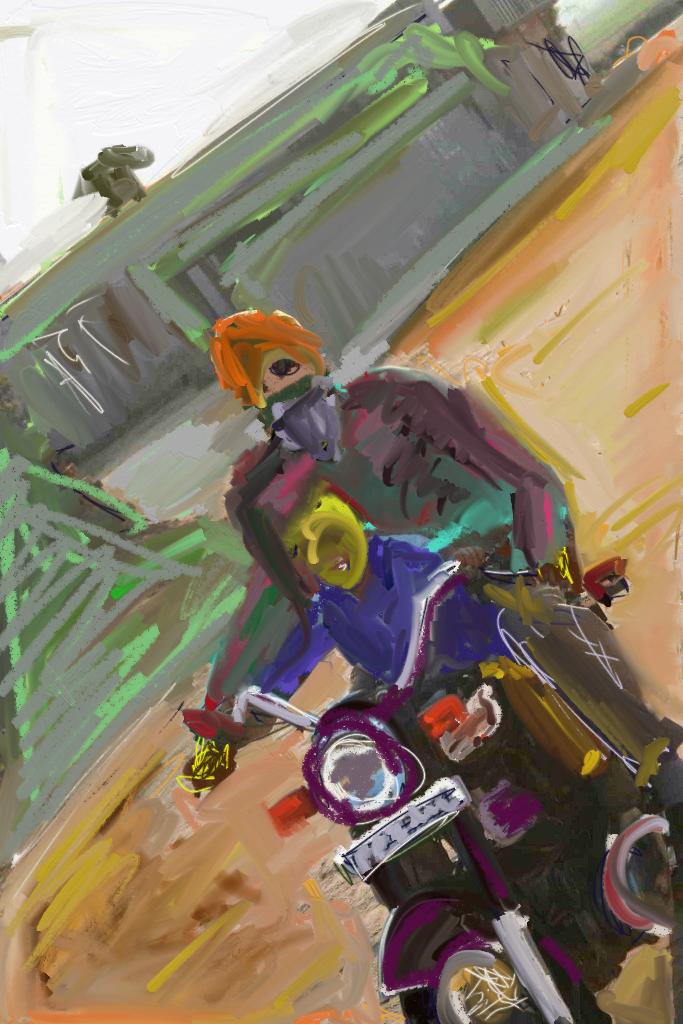 art: spent a good part of saturday over at my masi's. was playing with my cousin's notepad pc, which has this great drawing interface. attached is one of the resulting sketches. this was originally a photograph i shot while in india a few months ago. from this pc software, i am able to import an image, and then draw on top of it. i thought the sketch came out well, but felt a little odd about the process. i ran across this article at clickwalla on souza. it mentioned his obsession w/ a camera obscura, which apparently allowed him to project images onto his canvases from where he could paint. i recall being a kid and getting this little light desk thing that let me put a picture in it, and a piece of paper, and i could trace over the image. i was fascinated. like most kids around 11 years of age, reproducing realism was my artist ideal. much later in my art years, i can safely say its not a big deal to sketch things, but often it is a pain blowing up an image from a photo onto canvas to form a starting point for a painting. i can see why souza wanted to skip the effort, and get on w/ the more exciting aspects of his paintings. ameen and i started chatting about this last night - bottom line, is it sleezy in some way to follow such a process? i would think this argument would be considered settled by marcelles du champ's toilet hanging show many years ago. certainly the art world claims it is, nonetheless, i think deep down, even the most ardent "art is what the artist says it is" mantra chanters, have a problem with it. it took ameen 20 minutes and some pondering to finally conclude, yeah, its fine, so long as the artist doesn't hide the process in any way. i, however, think its fine, but am still feeling unsettled. why am i unsettled? if someone can hang a urinal up and call it art -- if legions can shoot photos and call it art -- if legions can accept both as art, why is it such a big deal for me to shoot one's own photo, project it, and jump start the composition process? oddly, it doesn't even bother me to now know one of my favorite painters followed such a process.
A Day in the Life of Mateo
My friend, whos adopted name is now apparently 'mateo', is having a hoot down in mexico. Since my life is far less exciting these days, with his permission, I'm posting a recent email he sent me. this one is titled: Prepare yourself for verbal diarrhea!
Life continues in the land of the sun. At the moment I have a bit of a cold, I think I got a chill last night because it was suddenly cold and I had the fan right on me all night. Its wierd to have a cold in a super hot climate. However its very mild and the old digestive system is running like a champ.
Not much new to report. Today was an excellent day, I got up at around 9 and went over to my friend Jerry's house around the corner to see if he could help me fix my moto, which hasn't been running since I got here. Instead he had to install a window at another friends house, an odd job he was doing, so we went over there instead. There we bumped into my friend Alexis who had dropped by to pick up some tiles for his house that Tony had bought for him, so I offered to help load them into my truck and carry them up to his house. Then Tony shows up and we hang out a bit and talk about his indian neem tree in the back yard and he shows me a plot of land next to his with a great view of the beach for 8000 dollars. We discuss possibilities. I read the introduction to "Rebel Sell" which I find very interesting, the premise is that the dominant counter-culture paradigm today is the "Matrix" like concept that we are all being manipulated by "the establishment", and the accepted leftie way to fight it is, like Nemo in the Matrix film, to refuse to accept the established world as is and pursue personal pleasure, since the ultimate act of rebellion in a media orchestrated world is to identify and pursue goals that you yourself want rather than the goals society sells you, (the book suggests that this paradigm is flawed and efforts to subvert the establishment simple serve to strengthen it) I borrow the book, we go visit Alexis's observatory he is building out of cob with a homemade thatched rotating doom roof for the telescope, we take some grass cuttings to plant at Jerry's house, there is a nice variety of grass Alexis is growing that is very strong and requires little water, then I drop back by Jerrys house, he invites me in for some leftover minestrone (Jerry is an italian who is opening a restaurant here in 4 months), I have a chance to flirt a bit with Ciara the sexy italian who is camping on Jerry's land, we eat the minestrone, a little bread, buon apetito, saver the local plant life, have some coffee, plan to go camping in the desert with the witch doctors over Semana Santa which is Easter, plan also to go to the big waterfall by Huatulco to go swimming next week, I ask Jerry for the email of a mexican friend who went back to DF, he looks for a while in a big pile of little scraps of paper and finds lots of things he forgot about but not my friends number, I remember I was supposed to help Coenraad and James build a cob pizza oven down in Arroyo 3 for the community center but am glad I forgot becuase the work site is in full sun and its nicer to just sit at jerrys house, outside under the shade roof he built, and look at the beach stretching down below only 200 meters away. So much here is homemade, if you want something like furniture you make it yourself or you get a friend to make you something. It occurs to me that during the whole day I never had the slightest idea where I would be or what I would be doing 30 minutes ahead, and that this might just be the best definition of freedom that I could come up with. Then I went back to my house for a liittle nap, afterwards I talk to the mexicans staying in the room next door, they tell me they come from a town in the mountains where mineral water comes out of the tap. I tell them they should post a big Welcome to -- sign outside their village announcing that the place is so great they even shit in mineral water, they think that is so funny they about fall out of their chairs laughing. My spanish is really coming along, you can measure it in terms of comic timing. Then Christopher and I go play soccer with the local team, 5 on 5, lots of fun, after sunset I come home shower and get sucked into a stream of consciousness email that is interruped by Karrie and James who stop by before walking down the beach to try Guille's fruiti di mare pasta at the last palapa hut on the beach. I read out the first half of my email and Karrie gives me her email address and asks me to send it to her as well. We agree to meet at the local watering hole in an hour for a drink. That's convenient because Luigi is bound to be there after his two day trip to the mountains for a little fresh air, and we have to talk about the company we have decided to start together. Mexican law requires that a company have at least 2 founders. He wants to build small scall water collection and maintenance systems here to sell to locals to improve local water usage and quality, which fits in well with my ideas. However Coenraad has suggested an idea I might have to coopt, which is to open a cafe that rents guitars to travellers on an hourly, daily, or weekly basis, and provides 15 minute starter lessons for anyone who wants to learn a few chords while they are hanging out on the beach, and in the afternoons you host a bob marley jam session for anyone who wants to play extremely simple songs and feel like a rock star. I think its a pretty good idea.
Thats pretty much what my days are like around here, when I'm not building cob or looking for land. I thought I found something pretty good but my latest feeling is that I could probably hold off and wait for a really good deal and keep my money for future projects... There are lots of deals to be had and I am reallly not in a hurry...
Hope you are well! By the way, I met a really great artist here who runs a restaurant, quite gourmet, probably the best restaurant in town, from Mexico City DF, you'd like his place. Ameen, your pictures look great on my wall by the way.
Ciao! Hope you are riding some snow once in a while for me. I'm currently listening to Sowehto's Where its At by Charlie Hunter, you know the song? Its so good, my latest favorite, not counting Come up to my Room by Princess Superstar which my dad would dismiss as "lower chakra stuff". You should play it at work once in a while. By the way I'm being turned on to lots of good music here. When I come back for a visit I'll have another hard disk full of stuff I think.
Matt (currently Mateo)
Life continues in the land of the sun. At the moment I have a bit of a cold, I think I got a chill last night because it was suddenly cold and I had the fan right on me all night. Its wierd to have a cold in a super hot climate. However its very mild and the old digestive system is running like a champ.
Not much new to report. Today was an excellent day, I got up at around 9 and went over to my friend Jerry's house around the corner to see if he could help me fix my moto, which hasn't been running since I got here. Instead he had to install a window at another friends house, an odd job he was doing, so we went over there instead. There we bumped into my friend Alexis who had dropped by to pick up some tiles for his house that Tony had bought for him, so I offered to help load them into my truck and carry them up to his house. Then Tony shows up and we hang out a bit and talk about his indian neem tree in the back yard and he shows me a plot of land next to his with a great view of the beach for 8000 dollars. We discuss possibilities. I read the introduction to "Rebel Sell" which I find very interesting, the premise is that the dominant counter-culture paradigm today is the "Matrix" like concept that we are all being manipulated by "the establishment", and the accepted leftie way to fight it is, like Nemo in the Matrix film, to refuse to accept the established world as is and pursue personal pleasure, since the ultimate act of rebellion in a media orchestrated world is to identify and pursue goals that you yourself want rather than the goals society sells you, (the book suggests that this paradigm is flawed and efforts to subvert the establishment simple serve to strengthen it) I borrow the book, we go visit Alexis's observatory he is building out of cob with a homemade thatched rotating doom roof for the telescope, we take some grass cuttings to plant at Jerry's house, there is a nice variety of grass Alexis is growing that is very strong and requires little water, then I drop back by Jerrys house, he invites me in for some leftover minestrone (Jerry is an italian who is opening a restaurant here in 4 months), I have a chance to flirt a bit with Ciara the sexy italian who is camping on Jerry's land, we eat the minestrone, a little bread, buon apetito, saver the local plant life, have some coffee, plan to go camping in the desert with the witch doctors over Semana Santa which is Easter, plan also to go to the big waterfall by Huatulco to go swimming next week, I ask Jerry for the email of a mexican friend who went back to DF, he looks for a while in a big pile of little scraps of paper and finds lots of things he forgot about but not my friends number, I remember I was supposed to help Coenraad and James build a cob pizza oven down in Arroyo 3 for the community center but am glad I forgot becuase the work site is in full sun and its nicer to just sit at jerrys house, outside under the shade roof he built, and look at the beach stretching down below only 200 meters away. So much here is homemade, if you want something like furniture you make it yourself or you get a friend to make you something. It occurs to me that during the whole day I never had the slightest idea where I would be or what I would be doing 30 minutes ahead, and that this might just be the best definition of freedom that I could come up with. Then I went back to my house for a liittle nap, afterwards I talk to the mexicans staying in the room next door, they tell me they come from a town in the mountains where mineral water comes out of the tap. I tell them they should post a big Welcome to -- sign outside their village announcing that the place is so great they even shit in mineral water, they think that is so funny they about fall out of their chairs laughing. My spanish is really coming along, you can measure it in terms of comic timing. Then Christopher and I go play soccer with the local team, 5 on 5, lots of fun, after sunset I come home shower and get sucked into a stream of consciousness email that is interruped by Karrie and James who stop by before walking down the beach to try Guille's fruiti di mare pasta at the last palapa hut on the beach. I read out the first half of my email and Karrie gives me her email address and asks me to send it to her as well. We agree to meet at the local watering hole in an hour for a drink. That's convenient because Luigi is bound to be there after his two day trip to the mountains for a little fresh air, and we have to talk about the company we have decided to start together. Mexican law requires that a company have at least 2 founders. He wants to build small scall water collection and maintenance systems here to sell to locals to improve local water usage and quality, which fits in well with my ideas. However Coenraad has suggested an idea I might have to coopt, which is to open a cafe that rents guitars to travellers on an hourly, daily, or weekly basis, and provides 15 minute starter lessons for anyone who wants to learn a few chords while they are hanging out on the beach, and in the afternoons you host a bob marley jam session for anyone who wants to play extremely simple songs and feel like a rock star. I think its a pretty good idea.
Thats pretty much what my days are like around here, when I'm not building cob or looking for land. I thought I found something pretty good but my latest feeling is that I could probably hold off and wait for a really good deal and keep my money for future projects... There are lots of deals to be had and I am reallly not in a hurry...
Hope you are well! By the way, I met a really great artist here who runs a restaurant, quite gourmet, probably the best restaurant in town, from Mexico City DF, you'd like his place. Ameen, your pictures look great on my wall by the way.
Ciao! Hope you are riding some snow once in a while for me. I'm currently listening to Sowehto's Where its At by Charlie Hunter, you know the song? Its so good, my latest favorite, not counting Come up to my Room by Princess Superstar which my dad would dismiss as "lower chakra stuff". You should play it at work once in a while. By the way I'm being turned on to lots of good music here. When I come back for a visit I'll have another hard disk full of stuff I think.
Matt (currently Mateo)
europe vs. radical islam
politics: i stumbled across this interesting book review in slate called Europe vs. Radical Islam - Alarmist Americans have mostly bad advice for Europeans by Francis Fukuyama. here is a snippet:
... the deeper source of Europe's failure to integrate Muslim immigrants, as Bawer recognizes, is not trendy multiculturalist ideas embraced by the left, but precisely Buchanan's blood-and-soil understanding of identity—a mind-set that until five years ago prevented a German-speaking third-generation Turk from acquiring citizenship because he didn't have a German mother. According to Bawer, "Europeans … will allow immigrants into their country; they'll pay high taxes so that their government can dole out (forever, if necessary) rent support, child benefits. … But they won't really think of them as being Norwegian or Dutch. And they'll rebel mightily against the idea of immigrants living among them as respected, fully equal professionals." American identity, by contrast, has from the beginning been more creedal and political than based on religion or ethnicity. Newly naturalized Guatemalans or Koreans in America can proudly say they are Americans. Pat Buchanan may not like it, but that is precisely what rescues us from the trap the Europeans are in.
you can read the full review HERE.
... the deeper source of Europe's failure to integrate Muslim immigrants, as Bawer recognizes, is not trendy multiculturalist ideas embraced by the left, but precisely Buchanan's blood-and-soil understanding of identity—a mind-set that until five years ago prevented a German-speaking third-generation Turk from acquiring citizenship because he didn't have a German mother. According to Bawer, "Europeans … will allow immigrants into their country; they'll pay high taxes so that their government can dole out (forever, if necessary) rent support, child benefits. … But they won't really think of them as being Norwegian or Dutch. And they'll rebel mightily against the idea of immigrants living among them as respected, fully equal professionals." American identity, by contrast, has from the beginning been more creedal and political than based on religion or ethnicity. Newly naturalized Guatemalans or Koreans in America can proudly say they are Americans. Pat Buchanan may not like it, but that is precisely what rescues us from the trap the Europeans are in.
you can read the full review HERE.
Monday, February 27, 2006
nostalgia realized

life: for much of my childhood summers, i'd toss wood in and out of pickup trucks, haul it around in a wheel barrow, chop it up w/ an axe, and stack it till my arms were sore. in the winter i'd come home from a long day skiing at the mountain, stoke up the fire, and hang my wet gear up to dry before the next day of mountain fun. i'd laze hours away half asleep by the fire, occassionally waking to finish some homework, or just poke the fire around. of course none of this mattered to me at the time - mostly the chopping and hauling were simply a pain. well i've spent the majority of the past 15 years since i left home woodstove-less, with the exception of some time spent at camp cody in bellingham, and for some odd reason, have longed to get my own stove. so, today was just a thrill. we installed a classic norwegian jøtul stove into the studio. after futsing the past couple months in repeated failed attempts to get our fancy pants radiant floor heat system to work, it was lovely harnessing simple medieval technology -- throw wood in, light match, enjoy heat. well now winters in the northwest can once again feel fine - douglas firs swaying under heavy wind, endless dark, rainy nights, and now, the cozy fire to make it all right.
Saturday, February 25, 2006
closer
 movie review: just saw mike nichol's film "closer." well, it was moderately entertaining. i really have a hard time liking films where i fundamentally don't like any of the characters. all of these people were quite annoying. julia roberts plays this depressive photographer that only shoots "sad" people; she casually almost-leaves her men repeatedly. then there are these 2 brit guys that are significantly annoying in there own way. one is a sort of whining literary adulterer type - the other a raunch obssessed dermatologist adulterer type. the only mildly redeeming character is played by natalie portman - who is this needy stripper girl, who eventually finds her own way, i guess. also, there were some bizarre chronology jumping going on. despite all this, it was shot well, the characters were reasonably well developed, fairly artsy and while julia roberts is in it, it has nothing to do w/ typical hollywood, which for me, is good. i give it 2 1/2 stars.
Thursday, February 23, 2006
civil war in iraq
since the day bush decided to invade iraq, i have been saying this will in all likelyhood result in 25 years of civil war, a war i believe will make lebanon's 25 years of strife seem relatively pastoral. i believe yesterdays bombing of Askariya, shiite islam's holiest shrine, is the turning point. i think the past year's activities have already proven iraq was in a civil war, but now it is undeniable to even the most ardent optimist. to the secular, it's difficult to illustrate just how terrible a crime this is. for believer's it is simple, and the emotional response can be sadly uncontrollable. with each passing hour, iraq is spinning toward a state from which it cannot return. already the revenge attacks have begun. many sunni mosques have been destroyed in retaliation. sunni imams have been killed assassination style. soon the sunni's will begin their revenge attacks for these revenge attacks. despite the near unanimous pleas of all leaders: secular, religious, iraqi, and non-iraqi, the cycle of revenge has begun. i think of the utter devastation caused in india driven by sectarian violence during partition, and my heart saddens. i can no longer see a reasonable outcome in iraq for many years to come.
Thursday, February 09, 2006
rumbles in rumble valley
life: i had a truly epic day at the mountain sunday. went up to camp cody on saturday night. spent the evening cozzying up to the woodstove with some good friends, wine, and laughter. then timothy, daniel and i went up to mt baker for a just stunning day. waist high powder all over the mountain. first tracks most of the day. its tough to pick the best run. dropping gun tower back into rumble valley was just delicious -- uncut, 27-degree-utterly-abnormal-for-the-cascades-light powder. first run out on the elbow was a hoot as well. for lunch we did a little relaxing out in the sun w/ a nice large sapporo and some tasty sweet potato fries. here are some nice pictures from the day on baker's site. all in all, a once in a few years day like this makes me, for atleast a few moments, want to return to the days where snowboarding was all i thought about.
Tuesday, January 31, 2006
ananya's first birthday
life: we had a great first birthday party for ananya on saturday. our friend jas put together THIS flash show.
Thursday, January 26, 2006
news spin
politics: well i must say, things in the middle east have taken a rather odd turn. what are we supposed to make of the palestinian/israeli situation now that hamas will be in the center of the political process? one of the things i find interesting about this situation, is how the press is not really sure what to make of it either. a few days ago, most stories seemed to run something like: the establishment verse the terrorists, with little real attention paid to why palestinians are actually voting for hamas. one exception was the christian science monitor, which ran this story a few days ago, Why Hamas is gaining in Palestinian polls. last night, i was particularly surprised to read THIS analysis on CNN - this was the most popular article on google news last night - it basically compares the israeli reaction to hamas winning, to that of the palestinians when sharon won - some sort of embrace of an unpredictable peace move... now today, the spin seems to be something like:
1. this is a protest vote against the corrupt PA
2. hamas will moderate itself now that its in the political mainstream.
3. hamas is terrible, and the peace process has nowhere to go.
the problem is the media is eternally optimistic, so they need to spin a path, however hypothetical, to peace, so 3. is not such a great take. 1. is a mere stating of the obvious. and 2. is well, editorial.
in any event, it kind of looks like the bush administration is in a bit of a jam. they need to spin how happy they are with the introduction of democracy in the middle east, but at the same time, its tough to spin hamas winning as a desired outcome. the CSM leads with, in my opinion, a no brainer article that should have been written the day the bush administration professed the desire to "let freedom ring" around the world. CSM writes:
Palestinian voters availed themselves of the time- honored democratic right to "throw the bums out" in their first legislative elections in a decade Wednesday - exactly the kind of action implicit in President Bush's push for democracy in the Middle East.
But by snubbing the Fatah Party of US-supported Palestinian President Mahmoud Abbas in favor of the radical Islamist group Hamas, Palestinians also put the Bush administration in a difficult spot.
The US might now seem hypocritical to many Arabs - encouraging democracy in the Middle East, while rejecting the choices that result from its exercise. At the same time, questions mount over whether Mr. Bush's campaign for democracy is encouraging the empowerment of Islamist militants across the region.
go HERE for the full text.
why is this a shock? one of the things that really bugs me about an exclusively-profit-driven-media is that there's so little analysis of positions occuring early on. i mean, its not like these are new issues, think of the franco-algerian war. why the heck can't the media use a little common sense and dare i say it, historical perspective, and analyze things a bit more. anyway, i should hardly pick on the CSM, they're one of the stars.
so back to the hamas thing, well, my take is that the bushies and israelies give this government a few days and a red line to decouple the militant wing of hamas from the service arm, else risk a complete cut off of funds. how that plays out, i have no idea.
1. this is a protest vote against the corrupt PA
2. hamas will moderate itself now that its in the political mainstream.
3. hamas is terrible, and the peace process has nowhere to go.
the problem is the media is eternally optimistic, so they need to spin a path, however hypothetical, to peace, so 3. is not such a great take. 1. is a mere stating of the obvious. and 2. is well, editorial.
in any event, it kind of looks like the bush administration is in a bit of a jam. they need to spin how happy they are with the introduction of democracy in the middle east, but at the same time, its tough to spin hamas winning as a desired outcome. the CSM leads with, in my opinion, a no brainer article that should have been written the day the bush administration professed the desire to "let freedom ring" around the world. CSM writes:
Palestinian voters availed themselves of the time- honored democratic right to "throw the bums out" in their first legislative elections in a decade Wednesday - exactly the kind of action implicit in President Bush's push for democracy in the Middle East.
But by snubbing the Fatah Party of US-supported Palestinian President Mahmoud Abbas in favor of the radical Islamist group Hamas, Palestinians also put the Bush administration in a difficult spot.
The US might now seem hypocritical to many Arabs - encouraging democracy in the Middle East, while rejecting the choices that result from its exercise. At the same time, questions mount over whether Mr. Bush's campaign for democracy is encouraging the empowerment of Islamist militants across the region.
go HERE for the full text.
why is this a shock? one of the things that really bugs me about an exclusively-profit-driven-media is that there's so little analysis of positions occuring early on. i mean, its not like these are new issues, think of the franco-algerian war. why the heck can't the media use a little common sense and dare i say it, historical perspective, and analyze things a bit more. anyway, i should hardly pick on the CSM, they're one of the stars.
so back to the hamas thing, well, my take is that the bushies and israelies give this government a few days and a red line to decouple the militant wing of hamas from the service arm, else risk a complete cut off of funds. how that plays out, i have no idea.
Sunday, January 22, 2006
bike swarms and acid etching
life: nayan had a birthday party to go to this morning. was down at the nordic heritage museum - a great time for the mini people. all the boys were racing around the play area on their bikes. most of the boys at the party had a second younger sibling. in all cases, the young ones seem to hobble and roam, solo, while being swarmed by speedy, though not quite stable, cycles. this, in normally quite uptight seattle is quite an aberration. typically seattle parents can be found micro managing the tiniest minutia of their kids' lives. what a pleasure to see parents just cruising about, young boys in unconstrained play, and toddlers meandering happily exploring their environment - all in all, a low key low stress birthday affair.
after b-day fun, i've spent the last couple hours applying vast quantities of acid to the floors of our studio. this lithochrome stain is seriously toxic stuff. basically, i spray it on, brush it into the concrete (while wearing thick rubber boots, gloves, respirator, goggles, etc.) it bubbles and gurgles and makes all kinds of noise. i have absolutely no idea whether it is going to end up looking good. the sample i did months ago looked great, unfortunately the floor seems to be behaving quite differently now. my gosh the sun is out. first time since i can remember. must go now.
after b-day fun, i've spent the last couple hours applying vast quantities of acid to the floors of our studio. this lithochrome stain is seriously toxic stuff. basically, i spray it on, brush it into the concrete (while wearing thick rubber boots, gloves, respirator, goggles, etc.) it bubbles and gurgles and makes all kinds of noise. i have absolutely no idea whether it is going to end up looking good. the sample i did months ago looked great, unfortunately the floor seems to be behaving quite differently now. my gosh the sun is out. first time since i can remember. must go now.
Friday, January 20, 2006
doorway trouble
life: so there's this 30 something wiggy new yorker guy who i'll refer to as NYX. for the past 4 years, every work morning, i park my car, i walk along the water front to work, and i see NYX smoking a cigarette. about 4 months ago, it was a nice sunny late august morning, and NYX was highly animated, upset and very agitated. as i got closer, i heard the following conversation:
NYX: "dddon't tell me i can't smoke here, ok!"
RandomMan: "sir, why are you getting upset? i simply asked if you could move down the sidewalk a ways instead of smoking right in front of the door lobby."
NYX: "look man, there's no &*&@# law against smoking in a door way okay! its not like i'm smoking in the &*@#&@ hallway. you people have pushed us out of everywhere!"
RandomMan: "i think you're a little too angry. i don't think its much to ask ..."
NYX, cutting off RandomMan: "look man! don't bring this @#@# up ok? i know the law, man, i'm a @#^@#^'ing lawyer. don't mess with me, or i'll sue the @^#%@^%# out of you."
RandomMan calmly walks away.
NYX starts shaking, and slowly moves out of the door way, cigarette in hand.
now, fast forward to yesterday. for those unaware, seattle has recently placed a smoking ban in all public establishments. not only can people not smoke inside any public building (bars, restaurants included), but people can no longer smoke within 25 feet of a doorway.
so, i'm walking to work, its pouring rain and pretty dark. i look up, and i see NYX standing in the middle of the street, about 25 feet away from the doorway. no jacket on, just jeans and a green sweater, and a cigarette.
NYX: "dddon't tell me i can't smoke here, ok!"
RandomMan: "sir, why are you getting upset? i simply asked if you could move down the sidewalk a ways instead of smoking right in front of the door lobby."
NYX: "look man, there's no &*&@# law against smoking in a door way okay! its not like i'm smoking in the &*@#&@ hallway. you people have pushed us out of everywhere!"
RandomMan: "i think you're a little too angry. i don't think its much to ask ..."
NYX, cutting off RandomMan: "look man! don't bring this @#@# up ok? i know the law, man, i'm a @#^@#^'ing lawyer. don't mess with me, or i'll sue the @^#%@^%# out of you."
RandomMan calmly walks away.
NYX starts shaking, and slowly moves out of the door way, cigarette in hand.
now, fast forward to yesterday. for those unaware, seattle has recently placed a smoking ban in all public establishments. not only can people not smoke inside any public building (bars, restaurants included), but people can no longer smoke within 25 feet of a doorway.
so, i'm walking to work, its pouring rain and pretty dark. i look up, and i see NYX standing in the middle of the street, about 25 feet away from the doorway. no jacket on, just jeans and a green sweater, and a cigarette.
Sunday, January 15, 2006
maya speaks

yesterday i went up to the mountain to do some snowboarding. its been dumping snow all week, but alas, it wasn't the fresh day i was hoping for. a few inches of new on top of some very wet heavy sloppy stuff. my sister and i did have a good time though. we managed a nice little hike at the top of stevens to get in a few decent uncut turns.
its amazing how utterly unmotivated i am to snowboard these days. it used to be such a huge part of my winter. after working all week, i really look forward to having unfettered time to just laze around the house w/ the kids. its dumping rain these days. i have atleast 4 points where water is seeping in to the studio. its a bit frightening, given that its the building's first winter, but fortunately, most of the leaks are relatively easy to resolve. my memories of winter as a child are so much brighter; i think it was all the days i spent at the mountain - snow brightens up your view. these dark gray days just seem to go on and on. i can't really complain, given that we missed most of winter this year.
i had a fun dream last night. i dreamt maya, our dog, could suddenly speak. unfortunately it was polish, so i couldn't understand her. i ran out the door trying to find someone who understood polish. by the time i got to the car, i forgot what language she was speaking, so i ran back inside to double check. and, of course, it was too late - she was back to dooberese.
Wednesday, January 11, 2006
macro-views
its over a week since we returned, and i'm still rising at 5AM. nayan wakes up at 4, and then eats his first breakfast. after feeding him, he roams the house playing with his toys. here's a post from a few days ago while back in india:
when i read things in the US, about the war in iraq, and political instability, i tend to put the information and my mental image of the place into a little box that i can open and close -- typically when starting and stopping a news article, or conversation on the topic. punjab, as most of you know, experienced quite a sustained period of insurgency and political instability. from the early 80s until the mid 90s, punjab was in essentially a state of war. sikh separatists were fighting for an independent nation to be called khalistan. it was a 'terrorist' style war that affected nearly everyone in punjab, my family included. one thing that strikes me while here, is that while society has returned to "peace and stability," the wounds of this period are still very fresh. another thing that strikes me, is that there are bizarre conspiracy theories for just about everything, including the khalistan question.
let me start by explaining my macro-view on the period of conflict. i should first say, i have a read a small amount and spoken with a number of people over the years, but i by no means have a thorough academic understanding of the subject. anyway, to distill a large complex topic into a couple lines, basically, here's my take:
1. sikhs, are a relatively prosperous people, and fierce warriors both respected and feared in pakistan and india.
2. we also have a violent history of battles to control greater punjab. (read kushwant singh's history of the punjab for more info).
3. in addition, india in general is composed of ethnically, religiously, linguistically, and culturally diverse people which have historically been segregated into independent "nations." the indian national identity is a relatively new phenomenon in the thousands of years of indian history.
4. in addition, india is a poor country with deeply entrenched corruption and an utterly innept and extensive beauracracy.
5. india and pakistan have been essentially at war since their foundings; india has never truly accepted that pakistan has a right to exist, and pakistan, feeling threatened, has struggled to break up the nation of india in an attempt to address its perceived threat by leveraging an understanding of point 3.
6. the US funded the mujahedeen in afghanistan to fight the soviet union back in the 80s. since the muj (1 of which is now the infamous osama bin laden) despised the american christian "infidels", the US had to route funding through the pakistani ISI (pak's CIA). well this was no small sum of cash, the ISI, routed a good chunk to the muj, but an even larger chunk went to itself, to essentially build a war chest, and fund what virtually amounts to an independent pak government.
ok, so what of the punjabi separatist movement? basically, a group of who i'll call separatists had legitimate grievances, harnessed a general spirit of economic malaise and tribalism to gain a modest voice, then morphed toward violent resistence. ISI saw an opportunity and started routing funds and started some training camps. the indian government mistepped a few times very signficantly (operation blue star), and popular support for the separatists rose, along with communal tension. then the government granted too much power to the police, in a society where virtually no checks and balances on the police exist. the police, not unexpectedly, ran amuck, killing lots of terrorists, but also many many innocents in their path. eventually, the police were able to drain popular support for the insurgency (mostly by making the situation so violent, that the populace just wanted it all to end), and stop it.
well i thought i would get further than that, but it turns out my couple lines grew into more. anyway, i'll come back to this topic sometime soon. my basic point was supposed to be, that a sort of intellectual analysis ending in a macro-view of a situation, is so utterly irrelevant. when you actually live through something like this, what you see means so much more.
a good friend of mine, who fit the visual profile of a terrorist (which i should mention included about 50% of all punjabi's), was brutally tortured on multiple occassions. only afer his family sold off ancestral land, raised a very large ransom, and paid off the police was he liberated. he figured out later that he was picked up, because a guy he had a conflict with in his juvenile college days was picked up, and under heavy torture, stated his name. this was a common occurrence, people took advantage of the situation to deal with their enemies. this friend went on to tell me many first hand accounts of utter brutality that were previously neatly wrapped up in my macro-view of these days as "instability." i often hear this here in punjab, that what one reads from afar, is so completely different from what those here who lived through these dark days experienced. hearing these first hand accounts from my friend really brought this point home for me.
when i read things in the US, about the war in iraq, and political instability, i tend to put the information and my mental image of the place into a little box that i can open and close -- typically when starting and stopping a news article, or conversation on the topic. punjab, as most of you know, experienced quite a sustained period of insurgency and political instability. from the early 80s until the mid 90s, punjab was in essentially a state of war. sikh separatists were fighting for an independent nation to be called khalistan. it was a 'terrorist' style war that affected nearly everyone in punjab, my family included. one thing that strikes me while here, is that while society has returned to "peace and stability," the wounds of this period are still very fresh. another thing that strikes me, is that there are bizarre conspiracy theories for just about everything, including the khalistan question.
let me start by explaining my macro-view on the period of conflict. i should first say, i have a read a small amount and spoken with a number of people over the years, but i by no means have a thorough academic understanding of the subject. anyway, to distill a large complex topic into a couple lines, basically, here's my take:
1. sikhs, are a relatively prosperous people, and fierce warriors both respected and feared in pakistan and india.
2. we also have a violent history of battles to control greater punjab. (read kushwant singh's history of the punjab for more info).
3. in addition, india in general is composed of ethnically, religiously, linguistically, and culturally diverse people which have historically been segregated into independent "nations." the indian national identity is a relatively new phenomenon in the thousands of years of indian history.
4. in addition, india is a poor country with deeply entrenched corruption and an utterly innept and extensive beauracracy.
5. india and pakistan have been essentially at war since their foundings; india has never truly accepted that pakistan has a right to exist, and pakistan, feeling threatened, has struggled to break up the nation of india in an attempt to address its perceived threat by leveraging an understanding of point 3.
6. the US funded the mujahedeen in afghanistan to fight the soviet union back in the 80s. since the muj (1 of which is now the infamous osama bin laden) despised the american christian "infidels", the US had to route funding through the pakistani ISI (pak's CIA). well this was no small sum of cash, the ISI, routed a good chunk to the muj, but an even larger chunk went to itself, to essentially build a war chest, and fund what virtually amounts to an independent pak government.
ok, so what of the punjabi separatist movement? basically, a group of who i'll call separatists had legitimate grievances, harnessed a general spirit of economic malaise and tribalism to gain a modest voice, then morphed toward violent resistence. ISI saw an opportunity and started routing funds and started some training camps. the indian government mistepped a few times very signficantly (operation blue star), and popular support for the separatists rose, along with communal tension. then the government granted too much power to the police, in a society where virtually no checks and balances on the police exist. the police, not unexpectedly, ran amuck, killing lots of terrorists, but also many many innocents in their path. eventually, the police were able to drain popular support for the insurgency (mostly by making the situation so violent, that the populace just wanted it all to end), and stop it.
well i thought i would get further than that, but it turns out my couple lines grew into more. anyway, i'll come back to this topic sometime soon. my basic point was supposed to be, that a sort of intellectual analysis ending in a macro-view of a situation, is so utterly irrelevant. when you actually live through something like this, what you see means so much more.
a good friend of mine, who fit the visual profile of a terrorist (which i should mention included about 50% of all punjabi's), was brutally tortured on multiple occassions. only afer his family sold off ancestral land, raised a very large ransom, and paid off the police was he liberated. he figured out later that he was picked up, because a guy he had a conflict with in his juvenile college days was picked up, and under heavy torture, stated his name. this was a common occurrence, people took advantage of the situation to deal with their enemies. this friend went on to tell me many first hand accounts of utter brutality that were previously neatly wrapped up in my macro-view of these days as "instability." i often hear this here in punjab, that what one reads from afar, is so completely different from what those here who lived through these dark days experienced. hearing these first hand accounts from my friend really brought this point home for me.
Wednesday, January 04, 2006
Monday, January 02, 2006
philoso-fi-zation
was at a dinner party w/ some interesting friends of friends. i've always known i know very little about philosophy, but now i'm convinced i know absolutely nothing.
back when i was in college, i loved the idea of hanging out in a cafe and being immersed in a nietzche book. i even went out and bought some despite being utterly clueless and drool dazed during my 15 minutes of browsing. i assumed some nugget of enlightenment would leap out and into my brain after a half day of staring at the pages. my highschool english teacher always warned us, "read that crap while sittin' on your kitchen counter. that way, when your face smacks onto the floor, you'll be nice and awake to start that paragraph over again."
after repeated attempts at "thus spoke zarathustra", no nuggets were jumping, and the kitchen counter trick didn't help much either. while i gave up trying to read this stuff, i never gave up having the books around. i liked them on my book shelf, and on the cafe table. after all, the image of the philospher was still so exciting to me. well after the fall of communism, 6 years of happy marriage (me-thinks some of this nonsense was typical teen impress-the-girl angst) and a conversation with my friend haitham (who's 7+ years into a PhD program at the university of chicago), i can safely say, the image isn't quite what it once was.
what bugs me about this field, and similar fields, is the intentional obfuscation of delivery. this group of friends is able to explain simply just about anything i ask about. so... why the heck can't the authors? i shouldn't just pick on philosophers, i find this phenomenon all over the place. the engineering equivalent of this is writing a technical paper while unnecessarily using inanely complex mathematics to describe a relatively trivial idea with moderately interesting results.
perhaps what i should be railing on, is the intellectual inferiority complex that drives one to obfuscate ideas. i mean, if you have a good idea, wouldn't you just want to clearly explain it so people know what it is? this whole diatribe reminds me -- i read this great geek analysis of post modernism. its called how to desconstruct almost anything - my postmodern adventure by chip morningstar and you can read it HERE.
back when i was in college, i loved the idea of hanging out in a cafe and being immersed in a nietzche book. i even went out and bought some despite being utterly clueless and drool dazed during my 15 minutes of browsing. i assumed some nugget of enlightenment would leap out and into my brain after a half day of staring at the pages. my highschool english teacher always warned us, "read that crap while sittin' on your kitchen counter. that way, when your face smacks onto the floor, you'll be nice and awake to start that paragraph over again."
after repeated attempts at "thus spoke zarathustra", no nuggets were jumping, and the kitchen counter trick didn't help much either. while i gave up trying to read this stuff, i never gave up having the books around. i liked them on my book shelf, and on the cafe table. after all, the image of the philospher was still so exciting to me. well after the fall of communism, 6 years of happy marriage (me-thinks some of this nonsense was typical teen impress-the-girl angst) and a conversation with my friend haitham (who's 7+ years into a PhD program at the university of chicago), i can safely say, the image isn't quite what it once was.
what bugs me about this field, and similar fields, is the intentional obfuscation of delivery. this group of friends is able to explain simply just about anything i ask about. so... why the heck can't the authors? i shouldn't just pick on philosophers, i find this phenomenon all over the place. the engineering equivalent of this is writing a technical paper while unnecessarily using inanely complex mathematics to describe a relatively trivial idea with moderately interesting results.
perhaps what i should be railing on, is the intellectual inferiority complex that drives one to obfuscate ideas. i mean, if you have a good idea, wouldn't you just want to clearly explain it so people know what it is? this whole diatribe reminds me -- i read this great geek analysis of post modernism. its called how to desconstruct almost anything - my postmodern adventure by chip morningstar and you can read it HERE.
Thursday, December 29, 2005
high tech toilets
on route, the asiana folks dropped us off at a hotel outside seoul for half a day to rest up. while i can't say i can see much of korea, i can say america is way behind in its bathroom technology. this hotel room is a serious gizmo force. it took me about 5 minutes to learn how to operate the toilet. i was a bit worried about pushing all kinds of buttons with phrases like 'rear cleanse' without making sure a rear was available for cleansing. the last thing i need is to be staring inside this toilet while i learn whether the massage feature is jet spray driven (it is).
the first thing that comes to my mind upon leaving india and entering a new western land is innevitably how clean it is. i've been to india so many times i can't count; i would expect this epiphany to fade, especially given that i'm so conscious of it. nonetheless, wow, its so clean out. i am staring out the hotel window looking down into an empty lot strewn with trash, and all i can think is wow, its so clean. this room is so clean. i get to drop my stinky shoes and change into cute little slippers on entering our room. ananya can roam freely and i don't have the usual paranoia driven urge to rub cleansing solution on everything.
i often spend time thinking about what actually causes the dirt in india. i've come to the conclusion that the causes are so multi-factorial. you have the obvious stuff: the fact that everyone throws their garbage out the window, the fact that pigs, cows, dogs, peacocks and people, being without access to massaging hi-tech toilets, take advantage of the roads and side walks. and of course there is the climate itself, brutal sun, sandy dirt, etc. the more time i spend in india, the less i want to think about this particular issue, mostly because i've thought it to death, and the topic gets so tiresome. but when i'm stuck in a taxi mulling over the choice between: staying inside with a driver that has not discovered the freshness of old spice, the waft of urine stenched air driven by the public avoidance of the even fouler public restrooms, and leaving all of our luggage unsupervised ( a definite no-no), its tough not to.
the first thing that comes to my mind upon leaving india and entering a new western land is innevitably how clean it is. i've been to india so many times i can't count; i would expect this epiphany to fade, especially given that i'm so conscious of it. nonetheless, wow, its so clean out. i am staring out the hotel window looking down into an empty lot strewn with trash, and all i can think is wow, its so clean. this room is so clean. i get to drop my stinky shoes and change into cute little slippers on entering our room. ananya can roam freely and i don't have the usual paranoia driven urge to rub cleansing solution on everything.
i often spend time thinking about what actually causes the dirt in india. i've come to the conclusion that the causes are so multi-factorial. you have the obvious stuff: the fact that everyone throws their garbage out the window, the fact that pigs, cows, dogs, peacocks and people, being without access to massaging hi-tech toilets, take advantage of the roads and side walks. and of course there is the climate itself, brutal sun, sandy dirt, etc. the more time i spend in india, the less i want to think about this particular issue, mostly because i've thought it to death, and the topic gets so tiresome. but when i'm stuck in a taxi mulling over the choice between: staying inside with a driver that has not discovered the freshness of old spice, the waft of urine stenched air driven by the public avoidance of the even fouler public restrooms, and leaving all of our luggage unsupervised ( a definite no-no), its tough not to.
night air
well we're back in seattle. we got in yesterday morning after a brutally long journey.
i woke up from one of my many naps, disoriented and lucidly waxing pseudo-logic; i was convinced it must be really late, since the neighborhood was abnormally quiet. it was 6PM and cars were returning home from work.
i've been staring into the night for hours now waiting for the sun to show up. it's raining, and i'm standing outside in our front yard just completely in awe of the quality of air i'm breathing. it strikes me that our impressions of the world are so relative to our experience. i'm sure 3 weeks from now, this air will seem slightly polluted and far inferior to the fresh breeze up in the mountains.
i woke up from one of my many naps, disoriented and lucidly waxing pseudo-logic; i was convinced it must be really late, since the neighborhood was abnormally quiet. it was 6PM and cars were returning home from work.
i've been staring into the night for hours now waiting for the sun to show up. it's raining, and i'm standing outside in our front yard just completely in awe of the quality of air i'm breathing. it strikes me that our impressions of the world are so relative to our experience. i'm sure 3 weeks from now, this air will seem slightly polluted and far inferior to the fresh breeze up in the mountains.
Monday, December 19, 2005
painting away

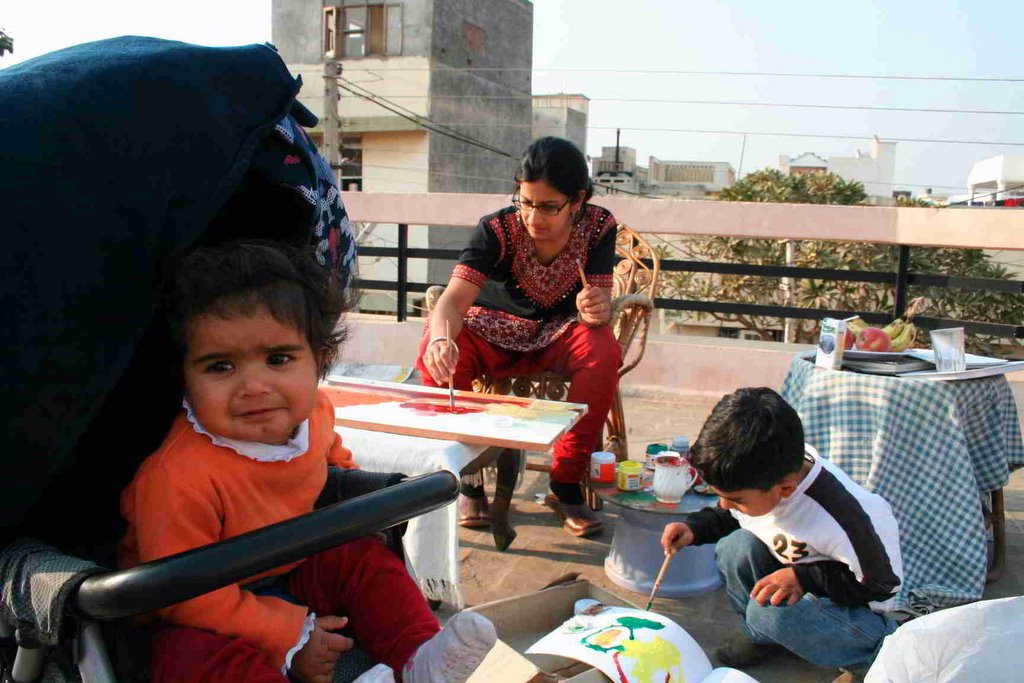


art: here are a few photos from the past few weeks. they're all taken on masi's cotie where we've been painting.
babas
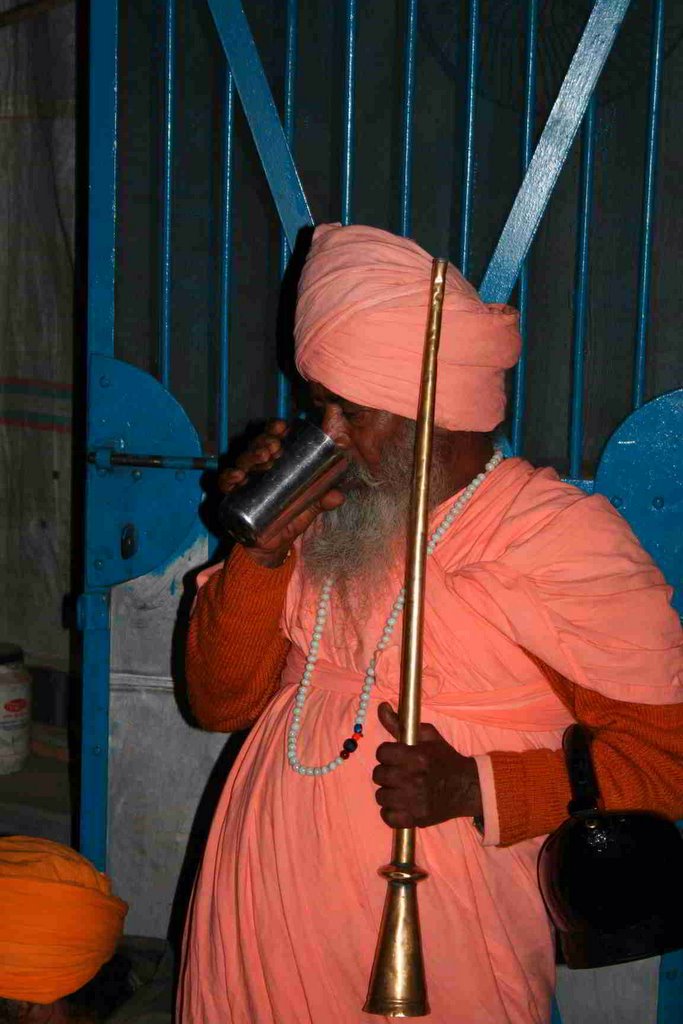 sukhi and gurpreet paji took me to a little buffalo house in a field of dirt with buffalo dung scattered about. i wasn't quite sure why. we walked in, and i saw many sadhus clad in orange robes, orange turbans, and long beards. for the uninitiated, sadhus are holy people, typically old men, that have left there families and all material possessions to wander from holy place to holy place.
we chatted with one of the sadhus for a while, then wandered into the buffalo house. one of the sadhus was wearing a white outfit and had no turban. gurpreet paji introduced me as the cousin from abroad, and said i had a deep spiritual question for the baba. then he and sukhi both started laughing. basically, i was left to put together the situation on my own. the baba breaks out in perfect english and says, "why are you here? is this a joke for you?" i stumbled for a bit trying to recover the situation, then asked him the first spiritual question that came to mind. basically i said something like "many religions: christianity, sikhism, hinduism, islam, have some notion essentially saying "God is everywhere and in all things." so, if this is true, then it means God can be in evil as well as good. is this true? he thought for a moment, went on a bit of a tangent, then i asked the same question again a few times. eventually he said something like, God is in you, that is the most important thing to focus on, purify yourself, and you will find God. that is the only path to God.
we wandered back to the open field area where lungar was being served to about 10 poor kids from local villages. my cousins introduced me to a rather large and old baba. he smiled and said, roughly translated, wonderful little one, what a great thing that you have come. this is a phrase that old people in villages often repeat over and over again to any young visitor. anyway, the main baba (holy person), smiled and walked away, then a few moments later, returned and said to my cousins, this means he is sant's sukha (true) nephew. we all nodded, then he got very excited, hugged me repeatedly, and started ordering everyone to get me milk, give me food, get me a manja to sit on, put parshad in my mouth, etc. sant mamaji (my mother's brother) and his father, my grandfather, gurbachan singh, had been going to this baba for many years. it turns out these sadhus, and this baba are rather unique, they are followers of sikhism, but also are devout hindus. many sikhs, and adherents to the later gurus, reject hinduism with its idol worship, and well, practice of asceticism. it turns out, the baba was given this land by someone many years ago to live in. he visits with villagers and they feed him and feel honored that he showed up. once a year, a group of sadhus from haridwar spends 14 days with him on route during a pilgrimmage to, i believe, rishikesh; but the details are foggy since my punjabi is not that hot, and i lose things when people are talking really fast.
in any event, i returned a few more times over the course of a few days. ameen came as well. we both loved it. i felt like it was such an incredibly authentic situation. there were only a few people in a field; there was no money, no press, no hope for anything bigger to happen, no drive to gather more people, convert anyone, or make this worship anything other than what it was.
i pulled out my camera one night - when the flash went off, the babas were all anxious. someone explained what was going on. they got incredibly excited that "the one whos returned from afar" was shooting pictures. someone had donated a car for the night to drive the main baba (the world leader of this group) to a prayer. on rare occasions they randomly show up at someone's house. they showed up at gurpreet paji's. everyone was thrilled, its considered a sign of good luck. i asked sukhi why - he said it happens on occasion - not many sikhs support them, and have houses free of meat, eggs and alcohol. he added while laughing, "well actually we have a few bottles lying around (for guests); we're just smart and keep them hidden."
Sunday, December 18, 2005
sukharan
 the past 3 days we've been in sukharan, my maternal ancestral village, staying with gurpreet paji (my cousin) and my mamiji (mother's brother's wife). it's been a blast and it appears nayan's intestinal friend is on its way out. sukharan is a small pind, about 70 houses surrounded by flat and fruitful farmland. we've spent a good part of the day chatting with all of our village elders about our family and the village history.
sukharan was started about 150 years ago by my grandfather's grandfather's grandfather himat singh. himat singh's father, fauja singh, lived in a yellow house in rotinda. i doubt the house was yellow some 200 years ago, or had a soccer ball water tank on the roof as it does now (we drove by the other day). anyway, fauja singh is the last of our lineage that my cousin sukhi can remember off the top of his head. without blinking, sukhi informs me of over 150 years worth of family lineage. he tells me that my grandfather gurbachan singh, had 2 brothers, one shiv singh, who's grandson is gurpreet. the other brother, banta singh, had one son charanjit singh, who's wedding pictures, all black and white, show photos of me, a spitting image of nayan at 5 years of age. his son is sukhi.
sukhi lives in another yellow house that himat singh first built when maharaja ranjit singh gifted him 500 acres of land for being a 'brave and fearless' brigadier general in the raja's army. for those who don't know, maharaja ranjit singh was the first and only sikh king to conquer all of the punjab, modern day punjab, haryana, himachal, much of kashmir, pakistani punjab, and lands into afghanistan. his reign rendered one of the few moments of calm in an otherwise violent punjab history, as much of the conquering was done via clever negotiation. after many more mukhi de rotis, our complete line was revealed: i.e., himat singh was the son of fauja singh, and father of mehtab singh (a colonel in the rajas army), father of gopal singh, father of inder singh, who was the father of our 3 grandfathers.
while writing this, i'm realizing this all reads like the introduction to a shakespeare play. anyway, over dinner, one of my mamijis reveals that himat singh's masi's (mothers sister) daughter was maharani jind kaur, the 7th (and i'm told most beautiful) of 7 wives of the maharaja. so it seems, her parents, after discovering a babe of a daughter, saw an opportunity to expand the family fortune. they convinced the maharaja that 6 wives was not enough, and that he should check out their daughter. well i guess it all worked out, since himat singh was made a general, and our family prospered. another interesting tid bit, himat singh, on leaving the army, and taking land in lieu of a pension for his service, left his home in rotinda, and travelled about 2 kilometers to build a house on his new land. he brought with him his faithful servants. the servants, now politically correctly referred to as 'aatarmi', or the oppressed ones, it seems have far outbred the jats.
we jats form the warrior caste (and farmers, since warring used to be a part-time profession) within hinduism. none of this caste stuff should matter since caste-ism is officially banned in both the indian constitution, and the sikh faith, but alas, it certainly does. nearly all the punjabi jats became sikhs beginning around the 15th century. i'm informed that now only 5 out of the 70 houses in the village are "ours," though nearly all of the land is. as i roam the village, everyone knows who i am. its a serene pastoral place; no buzzing scooters, sputtering auto rikshas, black cloud bellowing trucks, or skanky red paan stains. the local police are annoyed that there's "no money to be made in sukharan." translation: everyone gets along, no drunken fights followed by law breaking, and the need to bribe the police to get off. it's also true that i'm related to everyone (jats) in the village. we drink chai, and eat barfi at each of our 5 houses, the members of which all fit somewhere in the lineage down from himat singh.
sukhi informs me that in rotinda, all the jats are gosals. they're often called 'billean', or the cats, beacause nearly all have green eyes (a rarity in brown eyed india). only 1 of the gosal lines in sukharan got the bille gene. i am eating with one of my more distant mami's (mother's brother's wife) and i nearly jump out of my seat. i suddenly recognize her eyes, from 30 years ago. she was then veiled in black wearing garlic over her mouth, and red chilli peppers around her neck, screaching through the village chasing us children (its an old wedding tradition in our village). i was terrified. my sister, cousins and i lied shaking under a bed for hours.
sukhi says the gosal line moved to rotinda about 450 years ago. he's going to rishikesh this summer, where our family pundit can track our lineage back many more hundreds of years.
haveli and barbecues
so the kooseriah showed up again today asking about whether my cousin's had a son. ameen said yes, so even more drama ensued. ameen misunderstood them, and thought they were referring to veena's ( our cook) daughter's son, who indeed was born the day before.
today has been a relatively uneventful day. we painted in the morning for a few hours, then went to niko park, a local little kiddie park.
last night we went out to eat at haveli and rangala punjab. i suppose if anything represents the progress of india, it might be this place. some local entrepreneurs decided to make a restaurant w/ decor typical of old punjabi villages. the design work was extremely well done. they had handmade munji's that many of us remember from our pre-capitalism visits to india. the restaurant was so successful, that the founders expanded the company to reproduce an entire village. they went to villages and bought bricks and doorways from old houses being demolished. they also created a complete village using clay and other interesting materials. it has a bunch of random stuff thrown in, like the monkey guy that has 2 monkey's that do this ridiculous but engaging rendition of a monkey wedding, a magic guy, an entire bazaar, camel's and horses, bangra dancers, and my favorite, a parrot that predicts your future. what i thought was great about haveli was the quality of the execution. in punjab its pretty rare to see someone meticulously create a service business that doesn't eventually have the equivalent of duct tape everywhere, i.e. wires strewn about, decaying concrete, 70's foam ceilings, paan spit, bands of dudes staring blankly at you. here the bazaar was well done, the items for sale were all handmade crafts that are a dieing trade and tough to find, surdars serving food (an absolute rarity in india) with a smile and really great customer service. the place was also hopping w/ people.
of course it was topped off only by nayan screaming that it was a terrible place and he wanted to go home (we made the mistake of waking him up from his nap). the tantrum lasted well into this morning. it ended only after we brought out the usual "cops here beat little kids that cry with really big sticks." trick. to which he replied, "there's a cop, bring him over here, i want to barbecue him." after our driver, while laughing, agreed to go get him, nayan declared that he was just joking. so, it appears, our certain-to-psychologically-impare-our-son tactic of using the police threat to stop tantrums, appears to still work.
today has been a relatively uneventful day. we painted in the morning for a few hours, then went to niko park, a local little kiddie park.
last night we went out to eat at haveli and rangala punjab. i suppose if anything represents the progress of india, it might be this place. some local entrepreneurs decided to make a restaurant w/ decor typical of old punjabi villages. the design work was extremely well done. they had handmade munji's that many of us remember from our pre-capitalism visits to india. the restaurant was so successful, that the founders expanded the company to reproduce an entire village. they went to villages and bought bricks and doorways from old houses being demolished. they also created a complete village using clay and other interesting materials. it has a bunch of random stuff thrown in, like the monkey guy that has 2 monkey's that do this ridiculous but engaging rendition of a monkey wedding, a magic guy, an entire bazaar, camel's and horses, bangra dancers, and my favorite, a parrot that predicts your future. what i thought was great about haveli was the quality of the execution. in punjab its pretty rare to see someone meticulously create a service business that doesn't eventually have the equivalent of duct tape everywhere, i.e. wires strewn about, decaying concrete, 70's foam ceilings, paan spit, bands of dudes staring blankly at you. here the bazaar was well done, the items for sale were all handmade crafts that are a dieing trade and tough to find, surdars serving food (an absolute rarity in india) with a smile and really great customer service. the place was also hopping w/ people.
of course it was topped off only by nayan screaming that it was a terrible place and he wanted to go home (we made the mistake of waking him up from his nap). the tantrum lasted well into this morning. it ended only after we brought out the usual "cops here beat little kids that cry with really big sticks." trick. to which he replied, "there's a cop, bring him over here, i want to barbecue him." after our driver, while laughing, agreed to go get him, nayan declared that he was just joking. so, it appears, our certain-to-psychologically-impare-our-son tactic of using the police threat to stop tantrums, appears to still work.
Thursday, December 15, 2005
visitors
i haven't gotten a chance to post anything in a while. i do have a number of blog additions though. some are in long hand in my journal, others on my laptop. its such a pain to transfer them up. anyway, spent the day painting. nayan is finally off his antibiotics. things seem to be holding up, though he now seems to have come down with a cough, thankfully nothing serious. the baby is fattening up quite impressively. we're now on our way to mohalon to visit my thiaji as well as my cousin and family from the states.
its amazing the number of random people that show up at my masi's house during the day. the other day it was the 'koorah wallah' who wants cash for picking up the garbage. we also had the chonkidar show up demanding money for protecting the house; after repeated vists and much gafawing, we managed to convince him that no one lives in the house. the toy seller dude lingers sometimes for an hour in front of the house, blowing this dying goose sounding horn in an attempt to get nayan to start whining for a plastic gun. today the 'kooseriah' showed up demanding to know if my brother had a son. the kooseriah are the local eunach's, snipped and transvested, they arrive on the birth of a son to offer good blessings if well compensated, and threats to dance in the street naked if the cash is insufficiant. the dollar amount is amazing, like 500$ US, which is well over the average annual income. urban legend has it some of them cruise the streets in loked out mercedes. anyway, we managed to convince the kooseriah that i was not related (which is of course a lie, the father at issue is my cousin, which here certainly qualifies me to pay up), and that no son exists. we successfully convinced them only after repeating over and over and over that my cousins wife just got to the US a few days ago, so the requisite 9 months of baby incubation time had not passed.
its amazing the number of random people that show up at my masi's house during the day. the other day it was the 'koorah wallah' who wants cash for picking up the garbage. we also had the chonkidar show up demanding money for protecting the house; after repeated vists and much gafawing, we managed to convince him that no one lives in the house. the toy seller dude lingers sometimes for an hour in front of the house, blowing this dying goose sounding horn in an attempt to get nayan to start whining for a plastic gun. today the 'kooseriah' showed up demanding to know if my brother had a son. the kooseriah are the local eunach's, snipped and transvested, they arrive on the birth of a son to offer good blessings if well compensated, and threats to dance in the street naked if the cash is insufficiant. the dollar amount is amazing, like 500$ US, which is well over the average annual income. urban legend has it some of them cruise the streets in loked out mercedes. anyway, we managed to convince the kooseriah that i was not related (which is of course a lie, the father at issue is my cousin, which here certainly qualifies me to pay up), and that no son exists. we successfully convinced them only after repeating over and over and over that my cousins wife just got to the US a few days ago, so the requisite 9 months of baby incubation time had not passed.
Wednesday, December 07, 2005
the kids
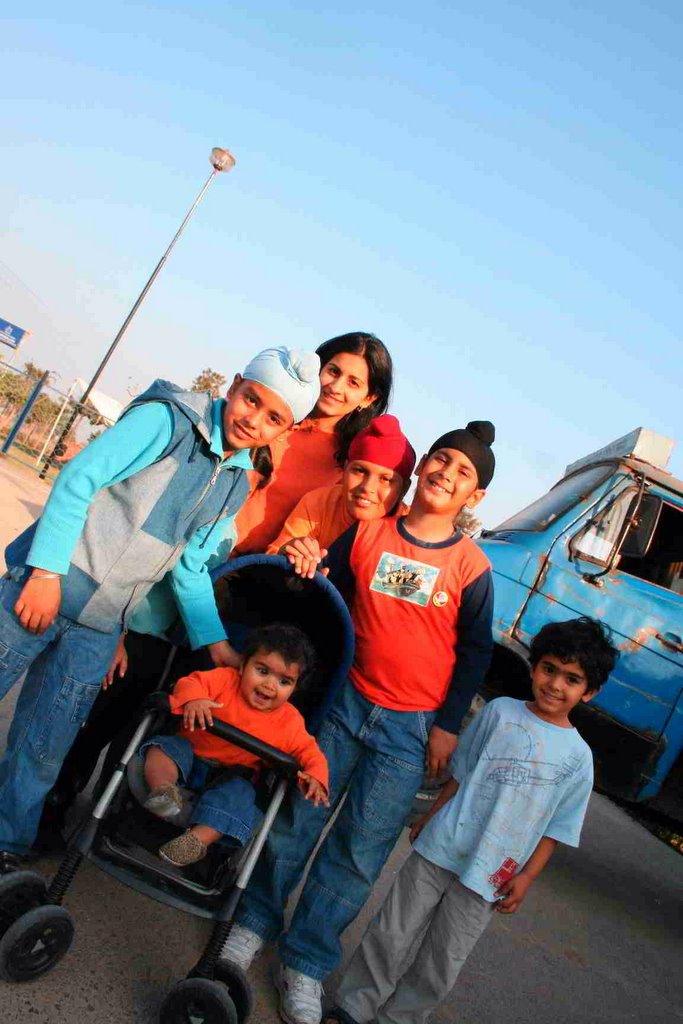 wow what a pain to post a picture with this brutally slow connection. anyway, here's a picture from the other day at wonderland. this would be moments before nayan was to encounter his intestinal friend which is sadly still with us, though fortunately not slowing him down much.
Monday, December 05, 2005
painting and nana devi
 art: just got back from masi's. spent the morning painting. pretty happy with how things are turning out. i got inspired by a francis souza painting. was an abstracted cityscape with heavy black outlines - bright and colorful inside the lines, lots of scratching and textural contrasts. i can't seem to find an electronic copy of the painting (its on the back of this month's art in india magazine for anyone motivated) - here's a link to some of souza's other work: http://www.srimatilal.com/souza/. since the subject matter is pretty convenient, i've been painting a lot of building facades borrowing a similar style. 3 paintings are nearing completion. still waiting for more of our canvases to arrive. a bunch of them were warped so we had jan bhai, our local art contact, redo them.
on other notes, it gets pretty cold here at night. the lack of heat and marble floors makes it more pronounced. its such a contrast from our hot days of painting outside on the cotie. we went to mohalon, my dhaadkes for a few days. we also cruised up into the himilayan foothills to visit naina devi. the road was terrible, but the views amazing. nayan had a great time w/ the many many monkies, though he learned quickly to stay close to us - they're extremely aggressive.
Subscribe to:
Comments (Atom)

